Many of these birds that I photographed at Crex Meadows, on one of my last trips there last October, have probably already returned to the area. I have already spotted bufflehead ducks, like the female pictured above, on the ponds near Black Dog Lake.Tuesday, April 7, 2009
Watery Wednesday: Crex Waterfowl
As the spring progresses many of the waterfowl have already begun to return to the north country. So far besides mallards and Canadian geese, which stay in the area all winter long, I have also seen many types of ducks return.
Many of these birds that I photographed at Crex Meadows, on one of my last trips there last October, have probably already returned to the area. I have already spotted bufflehead ducks, like the female pictured above, on the ponds near Black Dog Lake.
Many of these birds that I photographed at Crex Meadows, on one of my last trips there last October, have probably already returned to the area. I have already spotted bufflehead ducks, like the female pictured above, on the ponds near Black Dog Lake.Monday, April 6, 2009
My World: Maplewood Nature Center
Now that it is April it will not be long before the spring migration reaches Minnesota. Already migrating waterfowl have begun to move into the area and soon they will be followed by waders, raptors, songbirds and the rest.
I am looking forward to getting out to some of my favorite spots and actually getting to see a variety of bird life. One of those spots is the Maplewood Nature Center.
The Maplewood Nature Center is not very large, but it does have some really nice ponds that attract migrating and resident waterfowl.
One of the first ducks to return to the area, other then mallards who stay here year round, are the wood ducks. I have already begun to see wood ducks at several area ponds stacking out their territory.
One of birds that I frequently saw on the ponds of MCC last summer were green herons.
It is fun to watch green herons foraging through the shallow water and thick vegetation looking for small fish and invertebrates.
They slowly wade through the water their heads down and eyes on the water and when they find some prey they strike quickly with their long beak.
Sometimes you see them just sitting motionless at the waters edge waiting for an unwary prey to swim by.
There is also a small tree island in the main pond that was one of the best places that I visited last year to find fly catching birds.
The eastern phoebe is one of the most common flycatchers that wesee in Minnesota.
Another frequent visitor during the summer is the eastern kingbird.
They may not be as bright as their cousins the western kingbird, which are black and yellow, but they have a great personality.
The most exciting flycatcher that I saw at Maplewood was the olive-sided flycatcher. Since we are just at the southern edges of their summer range we do not always see these birds during August, when picture was taken.
It is fun to watch them take off from where they are perched at the top of a tree and do intricate maneuvers in the air. At first you are not sure why they be making acrobatic moves while they fly but when they land if you look closely you will probably see a fly, dragonfly or bee trapped in their beak.
Labels:
eastern kingbird,
green heron,
My World,
olive-sided flycatcher,
phoebe,
wood duck
Sunday, April 5, 2009
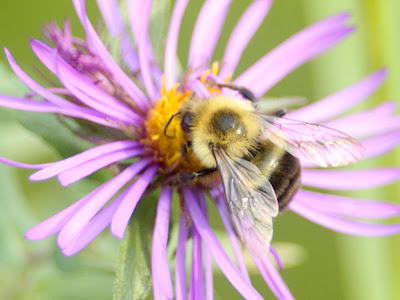
Today's Flowers: Bee on Purple-stemmed Aster
Bees are an essential component of the natural world. Through their foraging for nectar and pollen they, as well as butterflies and some other flying insects, pollinate many of the plants that the entire planet requires to survive.
Bees can also be deadly. When they sting they inject venom into their victim. This venom typically produces a localized allergic reaction which results in swelling, itching and pain. Some people however have a more serious anaphylaxtic reaction which can result in shortness of breath, major swelling, nausea, vomiting, fever, falling blood pressure and even possibly death.
My younger brother is hypersensitive to bee venom. When he was a kid he got stung and ended up having to go to the hospital. Unfortunately he is also allergic to Benedril, which is what they usually treat allergic reactions with, they did not know this at the time so when they treated him he had a pretty serious reaction. Fortunately I do not share his condition and have never had a serious reaction to the many bee stings that I have received during my life.
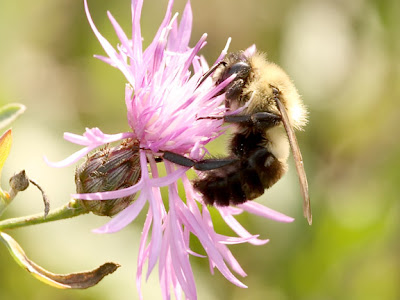
This bee is gathering nectar and pollen from an aster flower. It is most likely a purple-stemmed aster. You can see some of the purple coloration on the flower bud. The pictures were taken near the Old Cedar Avenue Bridge, which is a part of the Minnesota Valley NWA, back on September 26, 2008.
Bees can also be deadly. When they sting they inject venom into their victim. This venom typically produces a localized allergic reaction which results in swelling, itching and pain. Some people however have a more serious anaphylaxtic reaction which can result in shortness of breath, major swelling, nausea, vomiting, fever, falling blood pressure and even possibly death.
My younger brother is hypersensitive to bee venom. When he was a kid he got stung and ended up having to go to the hospital. Unfortunately he is also allergic to Benedril, which is what they usually treat allergic reactions with, they did not know this at the time so when they treated him he had a pretty serious reaction. Fortunately I do not share his condition and have never had a serious reaction to the many bee stings that I have received during my life.
This bee is gathering nectar and pollen from an aster flower. It is most likely a purple-stemmed aster. You can see some of the purple coloration on the flower bud. The pictures were taken near the Old Cedar Avenue Bridge, which is a part of the Minnesota Valley NWA, back on September 26, 2008.
Saturday, April 4, 2009
Pine Grosbeak Sax Zim 1-24
This winter was a good winter so see northern finches here in Minnesota. We had large irruptions of several species, including redpolls, pine siskins and white-winged cross bills that went further south and had larger numbers then usual.
Not all of the northern finches were down here in numbers this winter however, both evening and pine grosbeaks seemed to be missing in the great southern migration.
I did manage to find some pine grosbeaks up in the Sax Zim Bog area but I did not see any on my fist couple of trips up. It wasn't until the end of January that I began to see them and then only in small groups.
Pine grosbeaks live in the boreal forests of Canada, Alaska, and Eurasia where they feed on seeds, buds and fruit. During the winter they will migrate south if their is not enough available food.
During the winter, when food is sometimes scarce, they will find trees that still have fruit and stay near them until all of the fruit is gone. They often get their necessary water by eating snow during the winter time.
Pine grosebeaks are sexually dimorphic, meaning that there is a difference in appearance between the male and the female. The male is a brighter cranberry color, as in the first three pictures above, the female is more of an orange-gold color, as in the last two pics. It is difficult to identify first year males from females, since they are the same color until their second year when they begin to molt in their cranberry colored feathers
Not all of the northern finches were down here in numbers this winter however, both evening and pine grosbeaks seemed to be missing in the great southern migration.
I did manage to find some pine grosbeaks up in the Sax Zim Bog area but I did not see any on my fist couple of trips up. It wasn't until the end of January that I began to see them and then only in small groups.
Pine grosbeaks live in the boreal forests of Canada, Alaska, and Eurasia where they feed on seeds, buds and fruit. During the winter they will migrate south if their is not enough available food.
During the winter, when food is sometimes scarce, they will find trees that still have fruit and stay near them until all of the fruit is gone. They often get their necessary water by eating snow during the winter time.
Pine grosebeaks are sexually dimorphic, meaning that there is a difference in appearance between the male and the female. The male is a brighter cranberry color, as in the first three pictures above, the female is more of an orange-gold color, as in the last two pics. It is difficult to identify first year males from females, since they are the same color until their second year when they begin to molt in their cranberry colored feathersFriday, April 3, 2009
Swans at Crex
Here are some trumpeter swan pics that I took last October (10-20-08) at Crex Meadows.
These things that look like collars around the swans neck are actually bands.
When they get banded a US Fish and Wildlife Service band is usually placed around their leg, just the same way that other birds are banded.
The collar is just an extra band so that they can be identified by by sight or through a scope, something that would be very difficult on a leg band.
The color of the band identifies what type of swan that it is. Trumpeters have collars that are red, yellow or green. While tundra swans are given collars that are grey, blue or black.
Even though the collars are made of light plastic and are placed loosely around the neck there is some concern that the collars may present a safety risk to the swan. This is especially true in northern regions during the winter time. People have reported seeing swans with ice built up around the collar. The extra weight can affect their flight or worse yet can cause the swans to drown when it can no longer hold its head up out of the water due to the weight.
These things that look like collars around the swans neck are actually bands.
When they get banded a US Fish and Wildlife Service band is usually placed around their leg, just the same way that other birds are banded.
The collar is just an extra band so that they can be identified by by sight or through a scope, something that would be very difficult on a leg band.
The color of the band identifies what type of swan that it is. Trumpeters have collars that are red, yellow or green. While tundra swans are given collars that are grey, blue or black.
Even though the collars are made of light plastic and are placed loosely around the neck there is some concern that the collars may present a safety risk to the swan. This is especially true in northern regions during the winter time. People have reported seeing swans with ice built up around the collar. The extra weight can affect their flight or worse yet can cause the swans to drown when it can no longer hold its head up out of the water due to the weight. Thursday, April 2, 2009
Skywatch Friday: Lake Superior Sunrise
I took this picture back in 2005 at sunrise on a cold morning in Duluth, MN. We had spent a weekend birding out at the Sax Zim Bog but had spent the night in hotel in Canal Park. I got up early and took the shot from the beach behind the hotel.
The dilapidated building in the picture I believe is an old boat house that is now a part of the lake. The photo is a bit grainy because it was originally shot on film and then scanned into digital form. I have been finding that many of my old negatives are beginning to degrade so I am trying to get them scanned into the computer.
Subscribe to:
Posts (Atom)