The white-eyed vireo is a small passerine that breeds in the south eastern United States. They are typically found in scrub where they can often be seen hopping between branches gleaning insects from the bushes. They will also some times eat fruit. During the winter they migrate to their southern wintering grounds in Mexico, Central America or the Caribbean. I photographed this bird on South padre island. The South Padre Convention Center had a small garden with a man made stream running through which attracted many birds who had just made a long flight over the Gulf of Mexico.
Wednesday, June 18, 2014
Wednesday, June 4, 2014
Unusual Sighting
A few years back I took a trip out to the Necedah NWR in central Wisconsin. I began to travel to Necedah the year before because it is known for being one of the best places in the world to photograph endangered Karner Blue butterflies. On this particular trip it was early October, which is a bit late in the season for Karners, but I had a free weekend day and wanted to go photograph some place that I had not photographed so often. The day was going well, photographing primarily red-headed woodpeckers, when as I was walking along a dirt road I spotted a pair of large white birds flying my way. As the got closer I was excited to see that it was a pair of whooping cranes.
The whooping crane is one of the largest birds in North America and it is highly endangered. They stand about 5 feet tall and have over a seven foot wingspan. Because of habitat loss and unregulated hunting the population of the whooping crane dropped to just 15 birds by 1941. They were added to the endangered species list in 1967. Since this time their population has been increased slowly to about 400 - 500 birds today.
Most of the cranes, around 300 or so, are a part of a flock that breeds in Wood Buffalo Park in Canada and winters in Aransas National Wildlife refuge in Texas. This flock are the decedents of the remaining 15. However there is concern about the population since they breed and winter together in the same location. A disease, natural disaster, or man made disaster could easily wipe out the entire flock in one shot. In order to avoid potential disaster the Whooping Crane Eastern Partnership began to release birds into central Wisconsin. Young birds where then trained to fly to wintering grounds in Florida using ultra light aircraft. This project was based out of Necedah NWR. These birds are a part of the eastern flock, easy to tell because of the tracking bracelet on one of the legs, which now numbers over 100.
Wednesday, May 28, 2014
Tree Swallow
The tree swallow is a North American swallow. They nest through out Canada and the northern United states and migrate down to the extreme southern US, Mexico, Central America and the Caribbean for the winter. They typically do not migrate as far south as other swallows because they eat more seeds and plant material than other swallows so they can survive in cooler climates where there are fewer insects.
The tree swallow gets its name because it is a cavity nester and it is often found nesting in tree cavities. Tree swallows will also nest in nesting boxes that are placed in the right type of habitat. They prefer open habitats, such as fields and marshes, where they can catch their prey in flight. They also like to nest close to water because more flying insects are found around the water, due to the fact that the larva of many flying insects are aquatic.
Like most swallows the primary diet of the tree swallow consists of insects. They hunt from dusk to dawn, typically flying close to the ground and catching their prey in flight. This bird was hunting for nesting materials when I photographed it.
The tree swallow gets its name because it is a cavity nester and it is often found nesting in tree cavities. Tree swallows will also nest in nesting boxes that are placed in the right type of habitat. They prefer open habitats, such as fields and marshes, where they can catch their prey in flight. They also like to nest close to water because more flying insects are found around the water, due to the fact that the larva of many flying insects are aquatic.
Like most swallows the primary diet of the tree swallow consists of insects. They hunt from dusk to dawn, typically flying close to the ground and catching their prey in flight. This bird was hunting for nesting materials when I photographed it.
Tuesday, May 20, 2014
Snowy Owl
The snowy owl is a raptor of the northern tundra. They are circumpolar, nesting in northern portions of Alaska, Canada, Greenland, Europe and Asia. During the winter many of the adult snowy owls will stay on their nesting territory however many young birds may head south to southern Canada, the northern US, and central portions of Europe and Asia. They are the largest owl species, by weight, in North America and one of the largest in Europe and Asia.
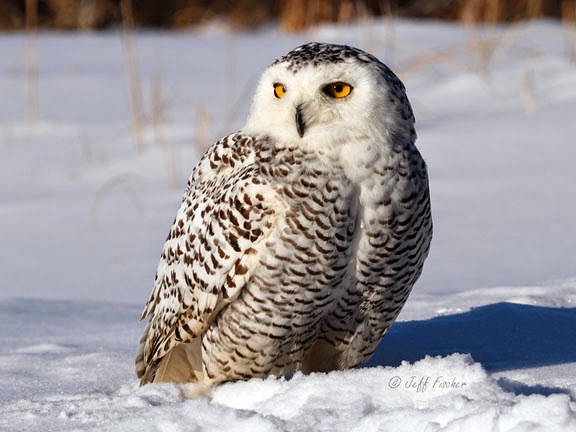
Young birds can be identified by their black barring. The barring is usually darker on the females then on the males. As they age the barring fades until adult males are almost pure white. Hedwig, from harry Potter fame is actually a series of male snowy owls. Females often retain some of the barring even as adults. Since some males are darker then normal and some female lighter it is best to use the size of the bib under the head to determine between the sexes. This bird has a small bib so it is most likely female. The other owl in these photos has a bib that extends half way down its chest so it is probably a male.

Snowy owls are more diurnal then most owls.It makes sense that they would have to be active during daytime hours during the nesting season, which runs from may through September. During the summer daylight can stretch to over 20 hours per day. Birds that stay on the nesting territory during the winter would have to switch to nocturnal hunting because of lack of daylight during the winter. The primary prey of the snowy owl are lemmings. They will also eat other small mammals as well as ptarmigan and water fowl.
Occasionally there are mass eruptions of snowy owls down into Europe, Asia, or the United States. These typically occur because of a lack of food in their tundra territories. this lack of food can be caused by a bad year for the prey species, such as a decline in the lemming population due to disease, or it can be caused by a particularly good breeding season. as a ground nesting bird snowy owls can lay up to 11 eggs in a clutch. most years a snowy pair can not support that many chicks and some do not make it. On a good year where there is plenty of prey during the breeding season more chicks survive and when it comes time for them to go out on their own in the winter many head south to find food. This past winter was a huge snowy eruption in the US. Snowies were seen all the way down in Florida. Most of the snowies that I spotted were immature birds which suggests that it was a good breeding year for snowies. Unfortunately many of the snowies that came south will never make it back.
Wednesday, May 14, 2014
Rowe Sanctuary
At the beginning of April I decided to take a short trip down to Nebraska to see the sandhill cranes. I had already been offered a job but since it took a while for the background check, drug test and all of the paper work to go through I decided it was the perfect time to head down to the Rowe Sanctuary. It had been many years since I last visited the sanctuary, I was still shooting film at the time, and typically the timing never seemed to work out. Either we were vacationing down south in late winter or we were heading to Yellowstone in May, either way it would be difficult to get away so close to another vacation. Since I was not starting work for another week I decided it would be a perfect time to go.
The Rowe Sanctuary is an Audubon sanctuary located in central Nebraska. It consists of 1900 acres of river channel, wet meadows and agricultural land along the Platte River. It is named for Lillian Annette Rowe who financed teh initial purchase of 782 acres back in 1974 to help protect the habitat for migrating cranes.
It is necessary to protect this part of the Platte River because it is the main resting spot for cranes migrating back north across the central flyway. Each year approximately 600,000 or more cranes stop at the Platte between mid February and mid April. This includes about 80% of the worlds population of lesser sandhill cranes. It also includes a good number of greater sandhill cranes and many other birds. The weekend I was there we saw a pair of endangered whooping cranes mixed in with the sandhills.The reason why they stop at this location is because the Platte is a shallow river with many sandbars. During the day the cranes venture through the bordering fields eating any left over grains. Since cranes do not have feet that allow them to perch in trees they spend the night standing in the shallow water of the Platte. The shallow waters act as an alarm to let them know if an terrestrial predators may be around. Each morning the cranes rise up from the river giving visitors a spectacular show only to return each night for an encore.
Wednesday, May 7, 2014
Quick
The peregrine falcon is the quickest animal in the world. Although they typically fly at speeds around around 40 - 55 MPH, which is slower then many birds and several mammals, they can hit speeds in excess of 200 MPH when hunting. Peregrines are bird eaters that frequently hunt by flying higher then other birds, over .6 miles and then dropping down on their prey in a dive called a stoop. In their stoop they can hit speed over 200 MPH with the fastest speed ever measured hitting 242 MPH. The peregrine has special adaptations that help it to fly at high speeds. The pointed shape of their wings makes them very aerodynamic. The also have posts in their nostrils, called nare baffles, that help to equalize the extreme air pressure associated with diving at these high speeds.
Peregrines are a world wide species that is found on every continent except Antarctica. The word peregrine means "wanderer" and they have earned this name because peregrines that nest in the tundra will often migrate over 7,500 miles to winter in South America or southern Asia. Peregrines living in more temperate climates typically stay on territory all year long, particularly the males. Their preferred habitat is areas around rocky cliffs where they nest. The nest is a depression called a scrape. The scrape is made by the female, who uses her talon to cut a depression on a cliff ledge about 2 " deep.In the 1950's and 60's the Peregrine falcons population fell to disastrous levels. Peregrines, along with numerous other species had suffered from DDT poisoning. DDT was a widely used insecticide that was passed up to the peregrine through insect eating prey birds. DDT did not affect the adult bird but it made their egg shells very thin, so that most eggs broke during incubation. Very few peregrines hatched and as the adults died through more natural means the population began to plummet. By the time that DDT was banned in the US, in 1972 peregrines had been extirpated from most of the eastern half of North America and were placed on the Endangered Species List. In the 1980's several groups, including the Peregrine Fund in the Eastern US, and the Midwest Peregrine Foundation in the middle of the US, began releasing young peregrines back into the wild. The eggs from these birds came from falconers and the young were placed in hack boxes until they fledged. Many hack boxes were located on tall building in cities and as the peregrine population began to rebound many were replaced with nest boxes. These additional nest boxes were placed on Buildings, bridges, smoke stacks and other man made structures and it provided the peregrines more nesting habitat in areas where their are not a lot of cliffs. The pigeon population in the cities also helped, provided the peregrines with abundant prey. The peregrine was taken off the Endangered Species List in 1999 and today they are thriving in many areas.
Labels:
ABC Wednesday,
peregrine falcon,
Wild Bird Wednesday
Tuesday, April 29, 2014
Palm Warbler
Late every spring warblers invade Minnesota. Starting typically in late April and running through the first few week of May warblers stop by on their way migrating north. How long that they stay depends n the weather. In years where we have an early spring they hardly stop at all but in years where winter lingers we can see them for a week or two. Last winter was a great year for photographing warblers. Winter lasted very late and when the warblers came through in May they stayed for a while because their were no insects to eat further up north. The late winter also meant that the trees had not leafed out yet which makes the warblers much easier to see. This year has the possibility of being another good year for warblers watching. We have had some warm days lately which has some of the trees budding but a cold snap this week with a possibility of a little snow might help slow things down just enough for us to et a good warbler showing this year.
One of the earlier species to come back through are the palm warblers. The reason that they are one of the first back is because they do not winter as far south as most warblers. They typically winter in the southern U.S and Caribbean, while most species of warblers head down to Central and South America for the winter. Palms breed in northern Canada. They are found mostly in the eastern half of North America. I often hear palm warblers before I see them. Instead of flitting around in the trees like most warblers they are usually foraging through the leaf litter, like a fox sparrow, looking for insects and seeds.
Labels:
ABC Wednesday,
palm warbler,
Wild Bird Wednesday
Thursday, April 24, 2014
Sunset Over the Platte
I would like to thank everyone who has come here this week to help us celebrate the 7th year anniversary of the ecobirder blog. Although life has limited the amount of time that I have to post I plan on continuing the blog for a long time to come. I took this photo of the sun setting on the Platte River in Nebraska a few weeks ago before I started my new job.
Tuesday, April 22, 2014
Osprey
One of the most interesting raptors is the Osprey. They are often called the fishing hawk but in reality they are not really a hawk at all. The osprey has its own genus (Pandion) and own family (Paninidae) of which it is the only member. So what makes the osprey so unique? The main difference is the osprey's feet. Most diurnal raptors, those that are active in the daytime, have one toe that is longer then the other three. This toe is called the hallux. It usually is the backward facing toe and one one that many raptors use to kill their prey. If you look at the young osprey being banded in the photo above you can notice that all the toes are relatively the same length. Also note that instead of 3 toes forward and one behind ( Anisodactyl) like other diurnal raptors this bird has two toes forward and two behind (Zygodactyl) like an owl. Osprey are able to switch back and forth.
Osprey feet also have pads on the bottom with tiny spines, called spicules, which help them to grasp fish. These adaptations on their feet help them to catch fish which makes up about 98 percent of their diet. Osprey are much better at fishing then bald eagles are, often diving up to 2 feet under the water to catch them. Osprey are found on every continent except for Antarctica. They do not nest in South America but birds from the northern portions of North America, like the birds in these photos which were photographed here in Minnesota, can migrate over 7500 miles a year from Canada down into central South America.
Monday, April 21, 2014
Seven Years
This Tuesday will mark the seventh year anniversary of the Ecobirder blog. I began the blog on Earth Day in 2007. In October of the 2007 I began as a volunteer at The Raptor Center. At first I began as on the Transport Crew. These are the people that go out to pick up injured birds. As a part of the Transport Crew I was happy that I was helping The Raptor Center fulfill their important mission but since I was only at TRC when I was dropping of a bird I did not feel like I was as involved as I wanted to be.
So I asked the Volunteer Coordinator if I could come into the center and help out during my transport shift. So they agreed to let me become a lobby assistant on Wednesday afternoon. The lobby assistants job is to greet visitors when they arrive and help out with the office administration. This was definitely a step in the right direction but I was still not completely satisfied. So I started bugging the staff and with in a couple of months I was able to worm my way on to the Education Crew.
When you begin on the education crew you spend most of your time cleaning. You clean the crates, you clean the mews and you clean the dishes. That is because one of the primary jobs of the ed crew is to take care of our 30+ education birds. The other primary job of the ed crew is to help educate the public about raptors and TRC. Eventually after training you get to begin interacting with the public by doing tours. Since I already knew a lot about raptors, after all I had been photographing them for about 20 years before beginning at TRC, it did not take me long to start giving tours. Eventually after a year in education I auditioned and began being trained as a handler.
So I asked the Volunteer Coordinator if I could come into the center and help out during my transport shift. So they agreed to let me become a lobby assistant on Wednesday afternoon. The lobby assistants job is to greet visitors when they arrive and help out with the office administration. This was definitely a step in the right direction but I was still not completely satisfied. So I started bugging the staff and with in a couple of months I was able to worm my way on to the Education Crew.
When you begin on the education crew you spend most of your time cleaning. You clean the crates, you clean the mews and you clean the dishes. That is because one of the primary jobs of the ed crew is to take care of our 30+ education birds. The other primary job of the ed crew is to help educate the public about raptors and TRC. Eventually after training you get to begin interacting with the public by doing tours. Since I already knew a lot about raptors, after all I had been photographing them for about 20 years before beginning at TRC, it did not take me long to start giving tours. Eventually after a year in education I auditioned and began being trained as a handler.
Handlers use many of the techniques of falconry to work with the birds. Handlers are responsible for doing programs for the public and private groups. They also help the staff reinforce positive behaviors by feeding the birds while they have them on the glove. The photos above are just 3 of the birds that I have handled over the past 5 years. Handling is one of the most rewarding experiences at The Raptor Center. Another rewarding experience is the occasional opportunity to release an eagle. This winter we had a lot of snow which made it very difficult for the Flight Crew to take the eagles out for their final practice flights. So as the snow melted we had a good number of eagles that were ready to be released. Since I had not released one since February of 2008 I had the opportunity to release this very handsome male at the Carpenter Nature Center at the beginning of April. My friend Les, who is a great photographer and a member of the Wednesday afternoon ed crew photographed the release for me. The other photos where taken by my old crew leader and TRC staffer Kelly Scott.
Subscribe to:
Comments (Atom)


