Showing posts with label Karner blue butterfly. Show all posts

Sunday, March 31, 2013

Karner Blue Butterfly

Karner Blue Butterfly
The Karner blue butterfly is one of nine species of butterflies on the North American Endangered Species List. Lycaeides melissa samuelis is a subspecies of the Melissa blue butterfly. The Melissa blue is found in the western half of North America where the Karner subspecies is found in the Great Lakes Region. The reason why the Karner blue has decreased in population is because it is very specific in the larval host food. The Melissa blue caterpillar feeds on various plants in the pea family. The Karner blue caterpillar feeds only on lupine which because of habitat loss and fire prevention has been decreasing in the Karner blue's natural habitat. As the larval host plant declines there is less food for the Karner caterpillars and so their population declines too. Fortunately there are still some places where the Karners thrive. This photo was taken at the Necedah NWR in Wisconsin. Necedah has one of the highest known Karner populations around, including this pair that was doing their part to increase the species population.


Wednesday, December 12, 2012

Karner Blue Butterfly

Karner Blue Butterfly
 Its always a treat when you get to photograph something that is rare. Most of the time this is something that is out of place, like the Inca dove that was in Two Harbors, MN a couple of years ago. If you go to Texas though Inca doves are pretty common. The most rare nature subjects to photograph are plants or creatures that are on the Endangered Species List. You do not make the ES list unless you are rare pretty much every where in the US. There are 9 species of butterflies on the North American Endangered Species List. One of the 9 is the Karner Blue. The Karner blue is a subspecies of the Melissa blue that is found around the Great Lakes. Unlike the rest of the Melissa blues the Karner blue larva, caterpillar  only eats the lupine plant. This plant has been decreasing in the wild because of human encroachment and fire suppression. As there is less lupine there is less food for the developing Karner blue larva and so their population has declined. I am fortunate that one of the largest remaining populations of Karner blue lives at the Necedah NWR in Wisconsin. So a couple of times a year I make the 3 hour drive each way so that I can photograph a butterfly that many people may never get to see in their life time.


Sunday, June 10, 2012

Karner Blue Butterfly

Karner Blue Butterfly
Since I had an extra day of for Memorial Day a couple of weeks ago I decided to take a small road trip to the Necedah National Wildlife Refuge in central Wisconsin. One of the main reasons that I travel to Necedah is to photograph the Karner Melissa blue butterfly. I thought about staying overnight in the near by town of Tomah, however due to the current political situation in Wisconsin I decided to take the three hour drive home that night.
Karner Blue Butterfly
The Karner blue is a subspecies of the Mellisa blue. Karners are found primarily around the Great Lakes region where the Melissa blue's are found mostly in the western half of North America. The biggest difference between the Karner blue and its relations is that the Karner caterpillar only eats one type of host plant, lupine. The amount of wild lupine, pictured with the butterflies above, has been steadily decreasing due to habitat loss and forest fire suppression. This decrease in their larval host plant has affected the Karner blue population to the point that they have been listed on the National Endangered Species List.


Monday, September 26, 2011

Karner Blue

There are about 1200 species, not counting the plant species, in North America that are on the US Fish and Wildlife Service's Endangered Species List. Many people are familiar with some of the larger mammals and birds, such as bison, cougars, whooping cranes, and California condors, but did you know that there are 10 different butterfly species that are also on the list.
Each year I make a trip or two out to Necedah NWR in Wisconsin. One of the big reasons for the trip is to photograph the endangered Karner blue butterfly. The Karner blue is a subspecies of the Melissa blue. It was named after Karner NY where it was first discovered. The Karner was classified as a separate sub species because it has a separate range, Karners are found around the Great Lakes while the Melissa is found through out western North America, and because it has a different larval host plant. The Melissa blue larva (caterpillar) feed on plants in the pea family, such as Astragalus, Lotus, Lupinus, Glycyrrhiza and Mediccago species, while the Karner larva feeds only on wild lupine. Since it is limited to one source of food the Karner blue population is limited by the amount of wild lupine. Unfortunately the amount of lupine growing in the range has been decreasing due to land development and a lack of natural disturbance, such as fire or large mammal grazing. Natural disturbances help to eliminate many of the other plants that tend to choke out the lupine.

Monday, February 7, 2011

Congrats Wisconsin

Last nights Super Bowl was a great game. I was very happy that our neighbors to the east came up victorious. To honor their victory I decided to feature one of my favorite Wisconsin refuges in today's post.
Necedah NWR is located in central Wisconsin. It is about an hour west of Madison, Wisconsin and about 3 hours south east of the Twin Cities, where I live. Our first trip to Necedah was back in 2007. I had been doing some reading about butterflies and found that Necedah was a good place to see the endangered Karner blue. Unfortunately by the time we made arrangements to go there, Michelle accompanied me on this trip, it was October which is a bit late for the Karner blues. We did fall in love with, and photograph the numerous red-headed woodpeckers living in the refuge. The head on this immature bird was just beginning to turn red.
In 2008 we decided to go back to Necedah but this time in June. We were able to photograph our first Karner blues on that trip but we did not see as many red-headed woodpeckers as we did in the fall of 2007. So I decided to head back, this time on my own, at the beginning of October. On the second trip not only did I get my red-head fix but I also was astounded when a pair of endangered whooping cranes flew directly over head.
In 2009 I made two trips back out to Necedah, one with Michelle and one on my own. This eastern tiger swallowtail was very cooperative that June, posing for many pictures on brightly colored flowers. On the June trip we also spotted a porcupine as it crossed the road, which was very exciting.
In 2010 I repeated my now traditional two trips, this year both of them on my own. I added several new species to my Necedah list including several new dragonflies and a bobolink. I also photographed my favorites including the red-headed woodpeckers and the Karner blue butterfly, as seen above.

Saturday, January 15, 2011

Lupine Today's Flowers


Wild lupine is a native member of the Fabaceae or pea family. They bloom in early summer and tend to grow better with a lot of sun. The blossoms grow in a spike type of cluster and usually come in a shade of purple.
Wild lupine can often be found growing in open fields and in road side ditches where the blossoms attract bees and butterflies. It is usually one of the first wildflowers to take hold in freshly cleared areas.
The amount of wild lupine in this area has been decreasing. As fields age other plants, trees and shrubs grow in and choke the lupine for space or rob it of sunlight. Originally this over growth was taken care of by occasional wild fires which would clear the field allowing the lupine to take hold again. Unfortunately because of fire maintenance by people the lupine has not been able to find as much habitat. This has greatly affected the Karner blue because its larvae will only eat lupine. Because of this the Karner Blue is on the endangered species list.

Monday, October 4, 2010

Necedah National Wildlife Refuge

Early this summer I made what has become an annual trip out to the Necedah National Wildlife Refuge located in central Wisconsin. Necedah is about a three hour drive each way but it is worth it because I get to see some species that I do not usually see around home.

One of the birds that I usually see in Necedah that I rarely see near home is the read-headed woodpecker. The population of the red-head is in decline do to habitat destruction. These birds rely on habitat with a lot of dead trees, which in many places are removed to limit the danger from forest fires. At Necedah the dead trees are left to naturally decay, even in areas that are control burned, so there is a thriving population of these bright headed woodpeckers.
Another bird that I have watched at Necedah that we do not usually see in the eastern portions of Minnesota are bobolinks. These birds are usually found in open grasslands. In Minnesota they are fairly common in the western part of the state but not so much on the eastern side where I live.
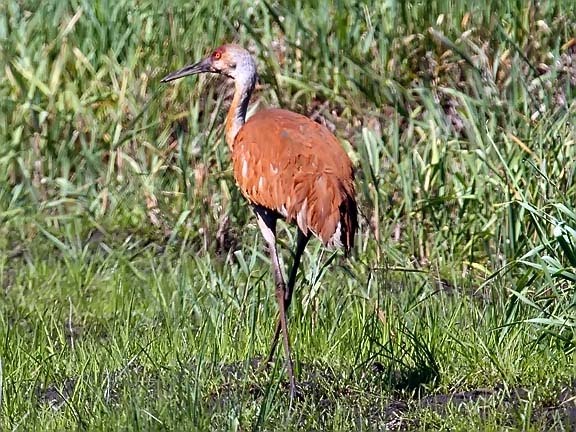
Necedah is one of the few places that you can see endangered whooping cranes. I did not see any on this trip but I have been fortunate to have them fly directly over my head at Necedah in the past. On this trip the only cranes in the field were sandhill cranes.
The main reason that I go to Necedah in the early summer is to photograph the endangered Karner blue butterfly. Karners usually have two broods through out the summer. The first brood emerges from their chrysalis in early June the second around mid August.
The Karner blue rely on wild lupine as the host plant for the larval or caterpillar form. Unfortunately it is more difficult to find lupine because bushes, trees, and other plants often block it from the sun that it requires. In order to spur new growth staff at Necedah performs control burns on different areas through out the park each year. The burning kills off the overgrowth and allows new life to take root. Lupine is one of the first plants to come in so the burns help to sustain the habitat necessary for the Karner blues to live and propagate.

Friday, September 24, 2010

The Endangered Karner Blue

Usually when people think of endangered species they think of big animals like elephants, gorillas, tigers, leopards, pandas and the like. Most of these animals are endangered because they require a lot of habitat to survive and as man has expanded that habitat has shrunk. However not all endangered species are large. Meet the Karner Melissa blue butterfly. This small butterfly, it has a wingspan of only about an inch, was added to the U.S. Federal Endangered Species list back in 1992 because it too s suffering from habitat loss.
The Karner blue is a subspecies of the Melissa Blue which is found in the great lakes region. Unlike the other Melissa blue, the larva or caterpillar of the Karner Melissa Blue will only eat the leaves of the wild lupine plant. Unfortunately the amount of wild lupine growing around the Great Lakes has been decreasing and consequently so has Karner blue population. Wild lupine grows in sandy soil in open spaces. Much of this space has been taken over by man for cultivation or urban sprawl. Other suitable habitat, that is not directly destroyed by people, often becomes quickly over grown. With out natural disturbances, such as fire, forests over run the fields making the habitat unsuitable for the lupine to grow. Since it is on the Endangered Species list the DNR in most of the Great Lakes States have begun to manage land to make it more Karner friendly. This is especially true in Wisconsin where the majority of the Karner population resides. I photographed these Karners at Necedah NWR in central Wisconsin.

Monday, August 24, 2009

Road Trip Necedah

Last week Michelle and I made a pretty big change. We decided to take my truck in and buy a new car. This is kind of a big deal because I have been driving trucks for twenty some years and not owned a car, other then Michelle's cars, since my first vehicle, but I decided it was time to do more to help the environment and my truck was only getting 15 MPG so it was time to trade it in for something a bit more fuel efficient.
So I bought myself a Honda Insight hybrid. For day to day I do not drive all that much, between 30 to 40 miles to work and back, but since I like to go out to photograph nature in a variety of different habitats I do put on a few miles doing road trips. So this weekend I took the new car on its first road trip to Necedah NWR in Wisconsin. Everything went perfect, the weather was nice, there was a good amount of wildlife to photograph, and the new car, pictured next to the Necedah sign above, worked great. The trip was 384.4 miles round trip and I used 9.1 gallons of gas, which means that I got over 42 MPG.
Since this is a nature blog and not a car blog I also took some pictures of wildlife while I was there. I was excited to see a pair of endangered whooping cranes out in the field in front of the observation tower, unfortunately they were too far away to get any good pics.
I did get some better pics of the red headed woodpeckers. They are quite common in Necedah. This is probably due to all of the dead wood that the staff leaves in the refuge. Red headed woodpeckers thrive in habitats where there is a lot of dead wood around. They use cracks and crevices in the dead wood to cache their food, this would include seeds, nuts, and even live insects.
Eastern kingbirds are also pretty common in Necedah. They can usually be found hunting for flying insects in the open fields.
Gray catbirds are usually more secretive. You are much more likely to hear one then you are to see one as they typically stay in shrubs or brush piles repeating their distinctive call.
Necedah is also a great place to photograph butterflies. It is one of the best places in the world to find the endangered Karner blue butterfly. The Karner is a sub species of the Melissa blue that is found mostly in the Great Lakes region. The Karner blue caterpillar is very particular and will only eat the lupine plant. As the amount of lupine decreases, due to habitat destruction and fire suppression, so does the population of the Karner blue. They have already disappeared from many areas where they used to be quite common.
Monarchs, on the other hand are quite common. They are probably the most recognized butterfly in the world. They really love blazing star, which are blooming all around Necedah at this time. They need a lot of nectar because they will begin migrating south soon.
Another butterfly that was partaking of nectar from the wildflowers of Necedah was the eastern tiger swallowtail. The eastern tiger swallowtail is common though out most of the eastern United States. It can be confused with the Canadian tiger swallowtail, which is a bit smaller then the eastern tiger swallowtail but other then that they pretty much look the same, in the northern states where their ranges cross over.