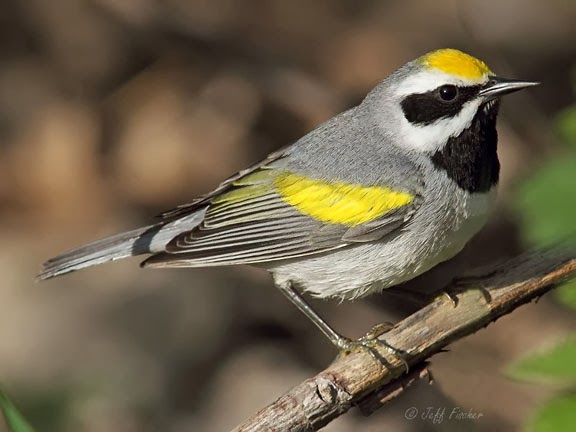


 2011 was a great year for photographing warblers. The winter lasted extra long so when the warblers came migrating through in May the trees had not leafed out yet. This made it easier to find and photograph small birds that normally hide in the foliage.
 Two warblers made the 2012 calendar. The top photo was featured in August. It is a Wilson's warbler which I photographed at the Minnesota Valley NWR. The second bird was featured in May and it is a golden-winged warbler. It was also photographed at the Minnesota Valley NWR.
 At the Detroit Lakes Festival of Birds back in May I visited the Tamarac NWR several times. Since the refuge is only about 18 miles away from Detroit Lakes it was a great place to go and shoot pictures whenever I got a break during the festival. Besides that I also signed up to take a half day field trip to the refuge.
 Tamarac was established back in 1938 as a breeding grounds for migrating birds. It consists of almost 43,000 acres of rolling forested hills mixed with lakes, rivers, bogs and swamps. It is named after the tamarac tree, a deciduous conifer that loses its needles each winter just like other deciduous trees loose their leaves.
  The main reason that I choose to go to Tamarac for one of my field trips was to try and get a picture of a golden-winged warbler. Even though these birds breed quite extensively in northern Minnesota and Wisconsin I had never seen one before, but Tamarac is known to be one of the best places to see them and on the field trip I got my chance. Despite the gray overcast weather that morning we ventured into a portion of the park that was closed to normal visitors and that is where I got my first sighting, and pics, of a golden-winged warbler.
 There were many other types of warblers around also. We spotted chestnut-sided, yellow warblers, American redstart, ovenbird, and Blackburnian warblers. I photographed this Blackburnian on the trails near the visitors center when I returned after the field trip instead of eating lunch.
 We did also spot some birds other then warblers. This veery did not seem to care much about a bunch of people walking through the woods. It landed on the path a few feet away and began to walk around searching for food. It stayed on the ground in front of us for several minutes before he food something to eat and flew away with it.
 Near the lakes and in some of the more marshy areas we found blue-winged teal, mallards, trumpeter swans, common loons, common yellow-throat and marsh wrens. I was able to snap a couple of shots of this marsh wren as he came to check out what was going on.
 One of the things that makes Tamarac so cool is that it is right in the area where three major biomes converge. The coniferous forest stretches down from the north, the northern hardwood forests from the east and the tall grass prairie from the west. Due to the convergence of these different biomes there is a diversity of flora and fauna here that you do not find in many other places.
 This includes a variety of different dragonflies. I was able to photograph quite a few new life dragons on this trip. The day that I arrived it was pretty slow on the dragon front with this American emerald the only dragonfly that I spotted that day. However by the time I left, two days later, several species had emerged and I was able to get pics of crimson-ringed whiteface, Hudsonian whiteface, belted whiteface, spiney baskettail and more.
 There were also butterflies to photograph like this tiger swallowtail that I found near the visitors center. I was hoping that this was a Canadian tiger swallowtail, since I already have plenty of pictures of eastern tiger swallowtail, but I was never able to get a shot with its wings closed so I will never really know.

