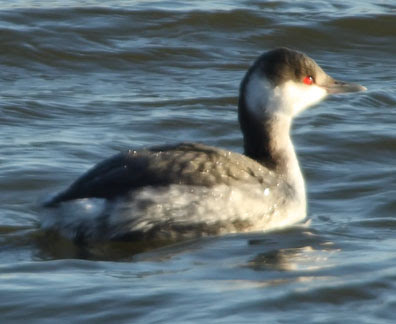
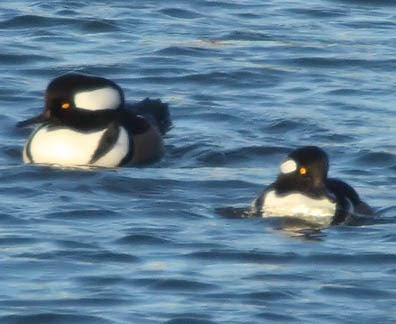
The best place that I found for photographing migrating waterfowl was Lake Hiawatha. This lake in south Minneapolis is one of several that is fed from Minnehaha creak. Since it is smaller then many of the other lakes around, it is usually where the ice melts first. This open water attracts migrating waterfowl who stop to feed on fish from the lake including northern pike, walleye and large mouthed bass. In 1922 when the lake property was purchased by the City of Minneapolis, Lake Hiawatha was just a swamp but the city transformed it over a number of years into a beautiful lake surrounded by a park and golf course. This year the lake had a number of common loons which is not uncommon but there was also a number of horned grebe in their breeding plumage. I took advantage of the rare opportunity to get a lot of horned grebe pics before they head up to their breeding grounds up in Canada. I also spotted bufflehead, common, hooded, and red-breasted mergansers, pied-billed grebe and numerous species of ducks. There was also a few eagles that circled above the lake for a few minutes and osprey diving into the lake after fish.
Showing posts with label horned grebe. Show all posts
Monday, April 29, 2013
Lake Hiawatha
So after a very long winter this weekend's weather was almost perfect, at least on my scale. We had mostly sunny days with highs in the lower to mid seventies. Since it is almost May I went out to a few of my favorite places to see if I could find some early warblers. The only warblers that I found were yellow rumps but I did find a lot of the migrating waterfowl was still around. Most of the time they would have moved on by now but because of our longer then normal winter many of the lakes up north still have ice on them. So many of the migrating waterfowl are holding tight until things get better up north.
Tuesday, February 15, 2011
Life List - Horned Grebe
The next category in my on going life list post is grebes. I don't think that I have any pictures of red-necked grebes, I am still checking some of my pics from Montana, but I was able to get some horned grebe shots back in 2008.
We do not see horned grebes very often in the southern part of Minnesota. Usually they pass through quickly on their way to their nesting grounds in northwest MN and Canada. In 2008 though we had a good number of them stick around a while. That Spring we had a lot of waterfowl hanging around because the weather up north of us was still a bit cold. I photographed these horned grebe at Fort Snelling State Park.Tuesday, July 14, 2009
Grebes
Since I got a lot of positive reaction from the grebe picture that I posted yesterday in my Yellowstone Fishing Bridge post I decided to repost some of my old grebe pics.
I first got interested in photographing grebes when I saw some pics of them, in their breeding plumage, online back in 2006. The photographer who took the pics, I do not remember who it was any more, had noted that he took the pics at Medicine Lake NWR in June. So I did some research on Medicine Lake NWR and found that it was not far off of the north route to Yellowstone. So when we were planning our 2007 Yellowstone trip we, Michelle and I, decided to cut a day out of photographing Yellowstone and make a side trip to Medicine Lake.
This turned out to be a good decision. The weather in Yellowstone was not very cooperative for us that year and it had a big effect on our ability to go out and take pics. Our day at Medicine Lake was just the opposite however. We had beautiful weather, there were lots of birds to photograph and we got some great eared grebe shots.
Then in the early spring of 2008, while I was photographing the heron rookery at the Upper Mississippi Regional Park I spotted a grebe bobbing around in the river. It looked similar to the eared grebe that we had photographed at Medicine Lake the previous year but it was a bit different.
This was the first time that I had seen horned grebe in their breeding plumage. They were not quite as spectacular as the eared grebe were but they were still a beautiful bird. I saw horned grebe in numerous locations around the Twin Cities that spring as they stopped by on their way north during migration. Unfortunately this year, 2009, was not a very good year for spotting migrating waterfowl in southern Minnesota and so I did not see any horned grebe this spring.Monday, April 28, 2008
Redhead, Scaup, Grebes, Flickers and Mergansers
I did also find some birds at Fort Snelling State Park on April 20th.
I have seen quite a few northern flickers around lately. Since they are pretty migratory it is possible that many of the birds that I have been seeing are on their way up to summer nesting grounds up in Canada. All of the flickers that I have seen are yellow-shafted northern flickers. The red-shafted northern flicker has a more westerly range. Perhaps I will get some pictures of a red-shafted when we travel to Yellowstone later this year.
Male redhead ducks are aptly named and easily identified, especially in breeding plumage. After the mating season is complete the males fly to large lakes, typically further north, where they group together. At that point they go through a molt which leaves them flightless for about a month. After the molt they appear pretty much brown all over but still maintain a red tinge on their heads.
Unlike its cousin, the greater scaup, the lesser scaup can only be found in North America. It is difficult to tell the two apart unless you have them right next to each other for comparison. However since the lesser scaup prefers fresh water, while the greater prefers saltwater, most of the scaups that we see here are lessers. From what I have read the best trait to use to identify whether you are looking at a greater or lesser scaup is the shape of the head. Lesser scaups have a thinner more rounded head then the greater do. My guess is that this was a lesser.
The horned grebes have been out in full force lately. Maybe it is just me, but it seems as though there are more horned grebes around this spring then normal.
A group of grebes, like the one pictured above, is not called a flock or a kettle it would be called " a water dance of grebes"
Another grebe that I spotted for the first time this year is the pied-billed grebe. Typically I have seen more pied grebes, around home, then any of the other types, but this year I have seen a lot more horned then I have pied.
Another bird that seems to be more numerous this year, at least where I live, are the red-breasted mergansers.
These birds are coming from winter grounds on the east or west coast of North America, as far south as Mexico, and are heading to their breeding grounds in the Arctic and Subarctic regions of Alaska and Canada.
I have seen quite a few northern flickers around lately. Since they are pretty migratory it is possible that many of the birds that I have been seeing are on their way up to summer nesting grounds up in Canada. All of the flickers that I have seen are yellow-shafted northern flickers. The red-shafted northern flicker has a more westerly range. Perhaps I will get some pictures of a red-shafted when we travel to Yellowstone later this year.
Male redhead ducks are aptly named and easily identified, especially in breeding plumage. After the mating season is complete the males fly to large lakes, typically further north, where they group together. At that point they go through a molt which leaves them flightless for about a month. After the molt they appear pretty much brown all over but still maintain a red tinge on their heads.
Unlike its cousin, the greater scaup, the lesser scaup can only be found in North America. It is difficult to tell the two apart unless you have them right next to each other for comparison. However since the lesser scaup prefers fresh water, while the greater prefers saltwater, most of the scaups that we see here are lessers. From what I have read the best trait to use to identify whether you are looking at a greater or lesser scaup is the shape of the head. Lesser scaups have a thinner more rounded head then the greater do. My guess is that this was a lesser.
The horned grebes have been out in full force lately. Maybe it is just me, but it seems as though there are more horned grebes around this spring then normal.
A group of grebes, like the one pictured above, is not called a flock or a kettle it would be called " a water dance of grebes"
Another grebe that I spotted for the first time this year is the pied-billed grebe. Typically I have seen more pied grebes, around home, then any of the other types, but this year I have seen a lot more horned then I have pied.
Another bird that seems to be more numerous this year, at least where I live, are the red-breasted mergansers.
These birds are coming from winter grounds on the east or west coast of North America, as far south as Mexico, and are heading to their breeding grounds in the Arctic and Subarctic regions of Alaska and Canada.Friday, April 25, 2008
My First Pics of Horned Grebe in Breeding Plumage
While I was out photographing the heron rookery at the North Mississippi Regional Park, at the beginning of last week, I noticed a small brown and black bird surface in the river near the shore where I was standing. I was excited because at first glance I thought that it was an eared grebe in breeding plumage. Last year on our Yellowstone vacation we swung a couple hundred miles out of our way to stop at Medicine Lake NWR, in Montana, just to photograph eared grebes in breeding plumage. Here is a photograph of an eared grebe in breeding plumage from last years trip.
Since I did not get a real good look at it before it dived back under the water I went down stream a bit and looked for it to surface. When I located the bird again I realized that it was not an eared grebe that I had spotted but I was close. It was a horned grebe in breeding plumage.
This was still pretty exciting because it was the first horned grebe that I had photographed in its breeding plumage. All of my past horned grebe pics, like this one below taken at Park Point in Duluth, MN last October, where of the birds in their non-breeding plumage.
I've got to say they look a lot cooler in the breeding plumage. Unlike a lot of ducks both sexes of horned grebes look the same so both male and female change plumage during the breeding season.
An interesting fact that I found out about horned grebes when I was reading up on them is that they eat their own feathers. These feathers form a plug or filter in the stomach that may fish bones until they can be digested. They even feed their feathers to their chicks so that they can start forming a plug.
My next goal is going to be to photograph both horned and eared grebe with their chicks. Like loons the young grebe chicks frequently ride on the backs of the adults. I would really like to get some pics of that. I will need to start working on researching good locations and times where I might find grebes with their chicks so that in the future I can bring you that shot.
Since I did not get a real good look at it before it dived back under the water I went down stream a bit and looked for it to surface. When I located the bird again I realized that it was not an eared grebe that I had spotted but I was close. It was a horned grebe in breeding plumage.
This was still pretty exciting because it was the first horned grebe that I had photographed in its breeding plumage. All of my past horned grebe pics, like this one below taken at Park Point in Duluth, MN last October, where of the birds in their non-breeding plumage.
I've got to say they look a lot cooler in the breeding plumage. Unlike a lot of ducks both sexes of horned grebes look the same so both male and female change plumage during the breeding season.
An interesting fact that I found out about horned grebes when I was reading up on them is that they eat their own feathers. These feathers form a plug or filter in the stomach that may fish bones until they can be digested. They even feed their feathers to their chicks so that they can start forming a plug.
My next goal is going to be to photograph both horned and eared grebe with their chicks. Like loons the young grebe chicks frequently ride on the backs of the adults. I would really like to get some pics of that. I will need to start working on researching good locations and times where I might find grebes with their chicks so that in the future I can bring you that shot.Thursday, December 20, 2007
Winter birding at Black Dog Lake
Last week I made another trip to Black Dog Lake on Monday after work. It was pretty cold out but the sun was shining. At first I went to check out the north side of the lake. There was a group of trumpeter swans as well as Canadian geese dabbling by the shore. However my attention quickly shifted away from them when I spotted a horned grebe diving for fish near the shore where I was standing.
I followed the grebe down the shoreline until he went further into the lake. When I returned the swans had moved too far away to get any descent pics so I decided to go back and check the open waters in the river. The water near the spill way is usually open so it is a good place to find ducks and other waterfowl like this pair of male hooded mergansers.
There was also an immature eagle flying around looking for some dinner.

I followed the grebe down the shoreline until he went further into the lake. When I returned the swans had moved too far away to get any descent pics so I decided to go back and check the open waters in the river. The water near the spill way is usually open so it is a good place to find ducks and other waterfowl like this pair of male hooded mergansers.
There was also an immature eagle flying around looking for some dinner.
Labels:
Blackdog Unit,
eagle,
hooded merganser,
horned grebe
Wednesday, October 24, 2007
Snow buntings and horned grebes at Minnesota Point in Duluth
After a week of days filled with either rain or gray skies or both, the weather reports said that we would have a clear and sunny Saturday on October 20th. I wanted to make another trip up to Duluth, MN before winter came so I decided that I would drive up that Saturday morning. I left at around 7am, the sun was just starting to light up the sky, and I arrived in Duluth around 9:30am. The drive was very nice. The weather was perfect, with deep blue skies and crisp fall air, and the scenery was a tapestry of fall colors.
Unfortunately as I approached Duluth I could see clouds moving in from the west and as I crossed the bridge onto Park Point a wall of clouds blocked out the sun. Since I had already made the trip, and there was not much that I could do about mother nature, I continued with my plans. I drove out park point spotting mallards, Canadian geese, several different types of sparrows, dark-eyed juncos, and several types of gulls as I drove. When I reached the end of the road I parked by the airport and hiked up to the beach of Minnesota Point. When I approached the lake I spotted 2 birds in the water near the shore. As I moved in to get some pics the birds dove under the water and swam out into the lake. I could see them well enough to identify them as horned grebes but they were not too far to get any descent pics. So I moved on to the east following the Lake. A ways down the shore I spotted a couple of snow bunting.

I almost did not see them, their winter, non-breeding, plumage blended so well into the sand.
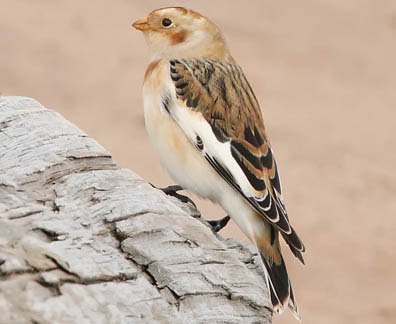
When I got close though they flew a little ways down the beach so I followed and got some shots. I did not see much more except quite a few people and dogs so I started back to the car. On the way back I saw that the grebes where back in close to shore again. This time I took a different approach to try and get some better grebe pics. When the birds were up I would stay still and when they dove under the water, after some breakfast, I moved closer to their location.
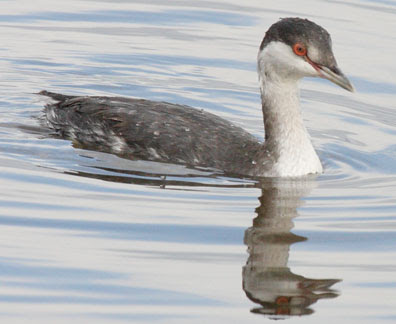
This strategy worked well. I was able to get pretty close to the wary birds.
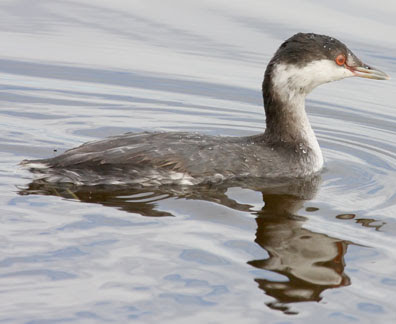
Once I got close I continued to follow them using this strategy. Every time they would go under I would move to where I thought that they would surface. Several times one of the birds would come up within a few feet from where I was standing.
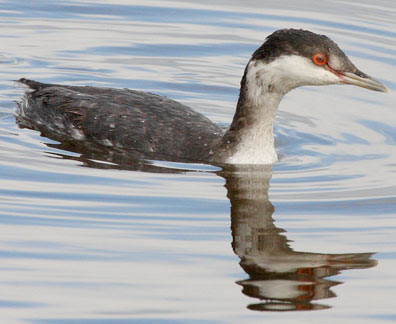
You know when you get detail in the eyes that you have gotten some good shots. It is just too bad that they are not in breeding plumage because they look much cooler when they are in breeding plumage. After a hiker with a dog kind of spooked them back out into the deeper water I decided to leave and make my way up to Hawk Ridge.
Unfortunately as I approached Duluth I could see clouds moving in from the west and as I crossed the bridge onto Park Point a wall of clouds blocked out the sun. Since I had already made the trip, and there was not much that I could do about mother nature, I continued with my plans. I drove out park point spotting mallards, Canadian geese, several different types of sparrows, dark-eyed juncos, and several types of gulls as I drove. When I reached the end of the road I parked by the airport and hiked up to the beach of Minnesota Point. When I approached the lake I spotted 2 birds in the water near the shore. As I moved in to get some pics the birds dove under the water and swam out into the lake. I could see them well enough to identify them as horned grebes but they were not too far to get any descent pics. So I moved on to the east following the Lake. A ways down the shore I spotted a couple of snow bunting.

I almost did not see them, their winter, non-breeding, plumage blended so well into the sand.
When I got close though they flew a little ways down the beach so I followed and got some shots. I did not see much more except quite a few people and dogs so I started back to the car. On the way back I saw that the grebes where back in close to shore again. This time I took a different approach to try and get some better grebe pics. When the birds were up I would stay still and when they dove under the water, after some breakfast, I moved closer to their location.
This strategy worked well. I was able to get pretty close to the wary birds.
Once I got close I continued to follow them using this strategy. Every time they would go under I would move to where I thought that they would surface. Several times one of the birds would come up within a few feet from where I was standing.
You know when you get detail in the eyes that you have gotten some good shots. It is just too bad that they are not in breeding plumage because they look much cooler when they are in breeding plumage. After a hiker with a dog kind of spooked them back out into the deeper water I decided to leave and make my way up to Hawk Ridge.
Subscribe to:
Posts (Atom)