Showing posts with label yellow garden argiope. Show all posts

Wednesday, January 30, 2013

The Spiders Web

Yellow Garden Argiope
 Most people have seen spider webs but have you ever wondered how spiders build their webs? Spiders produce silk from their spinneret glands which are located at the back side of their abdomen. Most spiders have 6 spinneret glands which are arranged in pairs. Some other spiders only have one pair of spinnerets while other have 8 spinnerets, or four pair. Each spinneret gland produces a different type of silk, or web, which has its own special purpose. Some threads are sticky and are used for catching prey, while other strands are not sticky and can be used for a variety of different purposes.  
Funnel Weaver Web
 Since there are a variety of different spiders and silk it stands to reason that there are a variety of different webs. The spider in the first pic is a yellow garden argiope. It is what is classified as an orb weaver spider. They create intricate webs which are used to catch prey. At the end of the day they will eat the old web, talk about recycling, and then spin a new one the next morning. Charlotte was a barn spider ( Aranea Cavatica) which is also a orb weaver. Some of the strands on the web are sticky so that they can catch prey while other strands are not sticky and allow the spider to move about freely. Another type of web is a funnel type (above). None of the strands on the funnel are sticky. Instead the funnel weaver sits in a hidden spot at the small side of the tunnel. When an insect flies into the funnel and becomes momentarily tangled the fast funnel weaver runs out and captures it before it can get away. Some of the funnel weavers in Australia are the deadliest spiders on earth.
Six Spotted Fishing Spider
Some spiders do not use their silk to help them catch prey. Fishing spiders, like the six spotted fishing spider above, often walk out on the water and kind of use it the way that a funnel weaver uses a web. When they feel a disturbance on the surface of the water, from an insect that fell in or a tadpole swimming by, they run across the water to catch their prey. Wolf spiders and jumping spiders are just a couple more examples of types of spiders that do not typically use webs to catch their prey. Even these types of spiders can still spin silk though. Many will use their silk to make an egg sack to protect their eggs. Others will spin a "dragline", as in the picture above. The dragline is a quick means of escape if the spider finds itself in danger. One minute the spider will be perched on a branch but as soon as it perceives danger it will drop rapidly from the perch using the dragline. Sometimes it will use it as a sort of chute sailing off into the wind on the dragline.   

Tuesday, January 3, 2012

Yellow Garden Argiope

yellow garden argiope in web with stabilimentum The yellow garden argiope, Argiope aurantia, is a large orb weaver spider. The body of the female argiope ranges from 19 to 28 mm long. As with many spiders the male is much smaller with a body length of only 5 to 8 mm. The yellow garden argiope is a diurnal spider, which means that they are active during the day. Each morning they construct a large web, often with a zig zag pattern, called a stabilimentum, down the middle, you can see a small example below the spider in the photo above. No one is sure what the purpose of the stabilimentum is but there are several theories including; camouflage for the spider sitting in the middle of the web, attracting insect prey by reflecting ultraviolet light, and a warning to larger creatures so that they do not accidentally destroy the web. Each night the spider will consume most of the web, digesting any tiny insects that might be stuck on the web and possibly recycling the silk so that she can rebuild the web the next morning.

Monday, August 15, 2011

Prairie Wetlands Learning Center

After my visit to Tamarac NWR I headed over to the Prairie Wetlands Learning Center in Fergus Falls to participate in a Minnesota Odonata Survey Project event. The morning started out with some showers and thunderstorms but by afternoon the sun was out and shinning.
The Prairie Wetlands Learning Center is a cooperative venture between the US Fish and Wildlife Service, the Minnesota DNR, and the city of Fergus Falls. It is the first residential environmental education center that is operated by the US Fish and Wildlife Service.
The center began as the dream of local conservationists in the Fergus Falls area. A grass roots effort began in the 1970s to create a facility, that was open to the public, that would focus on prairies and wetlands. In 1989 they formed the Friends of the Prairie Wetlands Learning Center to help to accomplish their goal.
Through a combination of private donations and public grants they eventually were able to fund the creation of the center in 1994. In 1998 they expanded by adding a visitors center and dormitory. In 2008 they expanded again and added an education wing which included six classrooms and a multi-purpose meeting room.
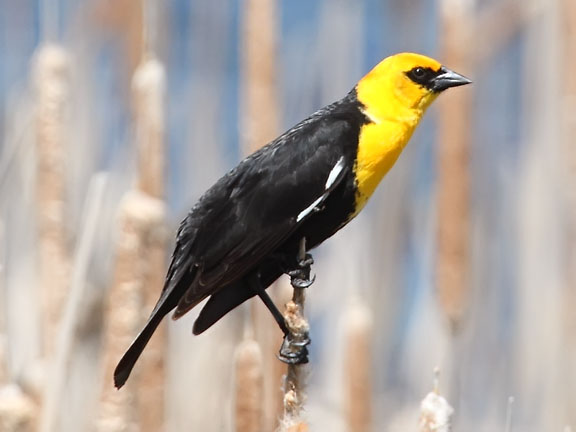
The center is a part of the Fergus Falls Wetland Management District and includes 330 acres of native and restored prairie, 28 wetlands, oak savannah and 3.5 miles of trails. Over 180 bird species have been identified on the property including the yellow-headed blackbird and purple martins pictured in this post.Unfortunately I did not see any new and exciting dragonflies, however there were some cool insects around for me to photograph. Two of the cool new insects that I was able to photograph were the Virginia tiger moth and the yellow garden argiope spider pictured above.