


 At the Detroit Lakes Festival of Birds back in May I visited the Tamarac NWR several times. Since the refuge is only about 18 miles away from Detroit Lakes it was a great place to go and shoot pictures whenever I got a break during the festival. Besides that I also signed up to take a half day field trip to the refuge.
 Tamarac was established back in 1938 as a breeding grounds for migrating birds. It consists of almost 43,000 acres of rolling forested hills mixed with lakes, rivers, bogs and swamps. It is named after the tamarac tree, a deciduous conifer that loses its needles each winter just like other deciduous trees loose their leaves.
  The main reason that I choose to go to Tamarac for one of my field trips was to try and get a picture of a golden-winged warbler. Even though these birds breed quite extensively in northern Minnesota and Wisconsin I had never seen one before, but Tamarac is known to be one of the best places to see them and on the field trip I got my chance. Despite the gray overcast weather that morning we ventured into a portion of the park that was closed to normal visitors and that is where I got my first sighting, and pics, of a golden-winged warbler.
 There were many other types of warblers around also. We spotted chestnut-sided, yellow warblers, American redstart, ovenbird, and Blackburnian warblers. I photographed this Blackburnian on the trails near the visitors center when I returned after the field trip instead of eating lunch.
 We did also spot some birds other then warblers. This veery did not seem to care much about a bunch of people walking through the woods. It landed on the path a few feet away and began to walk around searching for food. It stayed on the ground in front of us for several minutes before he food something to eat and flew away with it.
 Near the lakes and in some of the more marshy areas we found blue-winged teal, mallards, trumpeter swans, common loons, common yellow-throat and marsh wrens. I was able to snap a couple of shots of this marsh wren as he came to check out what was going on.
 One of the things that makes Tamarac so cool is that it is right in the area where three major biomes converge. The coniferous forest stretches down from the north, the northern hardwood forests from the east and the tall grass prairie from the west. Due to the convergence of these different biomes there is a diversity of flora and fauna here that you do not find in many other places.
 This includes a variety of different dragonflies. I was able to photograph quite a few new life dragons on this trip. The day that I arrived it was pretty slow on the dragon front with this American emerald the only dragonfly that I spotted that day. However by the time I left, two days later, several species had emerged and I was able to get pics of crimson-ringed whiteface, Hudsonian whiteface, belted whiteface, spiney baskettail and more.
 There were also butterflies to photograph like this tiger swallowtail that I found near the visitors center. I was hoping that this was a Canadian tiger swallowtail, since I already have plenty of pictures of eastern tiger swallowtail, but I was never able to get a shot with its wings closed so I will never really know.
 During this time of year I seem to spend a lot more time staring at the ground then I do looking up into the trees or the sky. Mostly I have been looking for dragonflies, which I have added a few to my life list so far this summer.
 I also photograph a lot of butterflies. In fact a couple of weekends ago I participated in the St Paul Audubon Societies Annual Butterfly Census. We saw quite a few of the common Minnesota butterflies but unfortunately nothing as large and amazing as a tiger swallowtail.
 I photographed this swallowtail at Necedah NWR in Wisconsin. It is most likely and eastern tiger swallowtail which are fairly common in southern Wisconsin. It also could possibly be a Canadian tiger swallowtail since the range of these two species cross over in Southern Wisconsin and Minnesota. It would be much easier to tell which type this was if I had been able to take a photo with its wings folded, however it is impossible for us to control nature.
 Last week Michelle and I made a pretty big change. We decided to take my truck in and buy a new car. This is kind of a big deal because I have been driving trucks for twenty some years and not owned a car, other then Michelle's cars, since my first vehicle, but I decided it was time to do more to help the environment and my truck was only getting 15 MPG so it was time to trade it in for something a bit more fuel efficient.
 So I bought myself a Honda Insight hybrid. For day to day I do not drive all that much, between 30 to 40 miles to work and back, but since I like to go out to photograph nature in a variety of different habitats I do put on a few miles doing road trips. So this weekend I took the new car on its first road trip to Necedah NWR in Wisconsin. Everything went perfect, the weather was nice, there was a good amount of wildlife to photograph, and the new car, pictured next to the Necedah sign above, worked great. The trip was 384.4 miles round trip and I used 9.1 gallons of gas, which means that I got over 42 MPG.
 Since this is a nature blog and not a car blog I also took some pictures of wildlife while I was there. I was excited to see a pair of endangered whooping cranes out in the field in front of the observation tower, unfortunately they were too far away to get any good pics.
 I did get some better pics of the red headed woodpeckers. They are quite common in Necedah. This is probably due to all of the dead wood that the staff leaves in the refuge. Red headed woodpeckers thrive in habitats where there is a lot of dead wood around. They use cracks and crevices in the dead wood to cache their food, this would include seeds, nuts, and even live insects.
 Eastern kingbirds are also pretty common in Necedah. They can usually be found hunting for flying insects in the open fields.
 Gray catbirds are usually more secretive. You are much more likely to hear one then you are to see one as they typically stay in shrubs or brush piles repeating their distinctive call.
 Necedah is also a great place to photograph butterflies. It is one of the best places in the world to find the endangered Karner blue butterfly. The Karner is a sub species of the Melissa blue that is found mostly in the Great Lakes region. The Karner blue caterpillar is very particular and will only eat the lupine plant. As the amount of lupine decreases, due to habitat destruction and fire suppression, so does the population of the Karner blue. They have already disappeared from many areas where they used to be quite common.
 Monarchs, on the other hand are quite common. They are probably the most recognized butterfly in the world. They really love blazing star, which are blooming all around Necedah at this time. They need a lot of nectar because they will begin migrating south soon.
 Another butterfly that was partaking of nectar from the wildflowers of Necedah was the eastern tiger swallowtail. The eastern tiger swallowtail is common though out most of the eastern United States. It can be confused with the Canadian tiger swallowtail, which is a bit smaller then the eastern tiger swallowtail but other then that they pretty much look the same, in the northern states where their ranges cross over.
 Even if the birding does not turn out as well this year as it has in the past I will always be able to find something to photograph and post on the blog. There was a slow start to the butterfly season last year, probably due to the late spring, but with the warm temps so far this spring I am hopeful that we will see more butterflies. The tiger swallowtails were difficult to find last year, with this one that I photographed at the Maplewood Nature Center in August being the first one that I saw last year.
 Each week bloggers take a look at the world around them and post for MyWorld. They take pictures of marvelous places that they share with their readers, but how often, when we are looking at the world around us, do we take a step back and notice the world beneath our feet. This is a world that is full of interesting creatures, that come in many exotic shapes and colors, that many people never take the time to explore. This week we will explore a small piece of this tiny world with pictures that I took on August 28th at the Carpenter Nature Center.
 Back when I was a kid I spent a lot of time tipping over rocks and looking at beetles. Back in those days there was no Internet, computers, or field guides for bugs the only thing we had was an outdated set of encyclopedias which were very little help. Even though I could not ID them I still liked to watch them. These days with help from the Internet I can at least make an attempt at identification. I believe that this may be a dogbane beetle which is a beetle that lives in the eastern portion of North America and feeds on the leaves of plants in the dogbane family.
 The Autumn or yellow-legged meadowhawk is easily distinguished from the other red colored meadowhawks by the fact that they have yellow legs instead of black. The Autumn meadowhawk is a late bloomer, meaning that they do not begin to mature into dragonflies until late July, so they are one of the most common dragons that are still seen in October and even early November depending on the weather.
 The eastern tailed-blue butterfly is a very small butterfly that is often over looked. They look similar to their cousins the western-tailed blue but the eastern version usually has two orange spots on the wings. On this example it appears that the second orange spot on the far wing has been worn and lost much of its color but it definitely has two spots on the bottom of the near wing.
 The monarch butterfly is the most recognizable butterfly in North America, and perhaps maybe even the entire world. The Caterpillar of the monarch feeds exclusively on members of the milkweed family, which makes the monarch toxic to most predators.
 Many people are aware that monarchs, like birds, fly south for the winter, however this is not true for many monarchs. In the northern portion of North America we typically see two broods of monarchs each summer. The first brood of the summer are the offspring of monarchs that hatched in the south. They intern will produce a brood that will migrate south and then they will die. It is the second brood that we gather together in September and fly down to wintering grounds in Mexico or southern California. At the wintering ground they gather together and go into a hibernated state until the spring. When they wake up from hibernation they lay their eggs and then die and this is how the species continues.
 I believe that this butterfly was an eastern tiger swallowtail but it is difficult to be sure since most of the edges of its wings are missing. The other option would be a Canadian tiger swallowtail, Carpenter Nature Center is with in the range of both versions, which has a continuous yellow band on the edge of the fore wing. There is also a black form of the female tiger swallowtail that looks very similar to the black swallowtail.
 So if you are lucky enough to live in a place where it is already warm enough for insects to survive take a look at the flowers, in the long grass, at the local pond or under a rock because you might find something really cool and interesting to look at. For those of us up here in the north we will still have to wait and be happy just to look at pictures.
 Near the boardwalk that goes out over the southern bass pond I spotted an american goldfinch.
 I sat and watch for about 15 minutes as the finch pulled seeds out of a pod.
 He would strip the silky parachute threads from the actual seed
 Then he would discard the threads and eat the seeds
 Sometimes it is more fun to watch them eat the natural way then to eat at bird feeders.
 In the same area there were several eastern tiger swallowtail sipping nectar from the blooming flowers.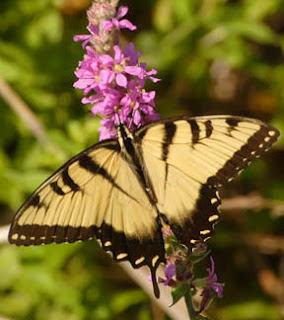

 Some of the swallowtail had some damaged wings.
 I took some pictures of other birds and butterflies that afternoon but I will post them later so that I can keep with my gold theme for this post.


