


 This May I have spent a lot of time photographing warblers. The late spring helped to hold off the trees from leafing out which gave me some spectacular views at warblers that stopped on their way migrating north. One of the places that has been good for spotting warblers in Crosby Farm Park. Usually I spend a lot of my time at Crosby around the boardwalk that leads through the wetlands. Last year I got some great shots of American toads calling at this location.
 When looking for warblers however, trees are important habitat. So I decided to head out on the trail that follows the river on the south side of the wetlands. Many of the trails were still wet or full of mud due to the flooding of the Mississippi River. Fortunately we are near enough to the beginning of the Mississippi so our troubles were not as severe as they are currently experiencing down south.
 I found numerous warblers on my couple of visits to Crosby. The most common warbler that I saw was the yellow-rump warbler. Yellow-rumps are usually the first warblers that we see in the spring and the last that we see each fall because they do not migrate as far south as the other warblers. Because of the weather and lack of leaves it was not difficult to find the warblers the hard part of photographing them was separating the other warblers out from the yellow-rump, which were about 95% of the warblers that I saw.
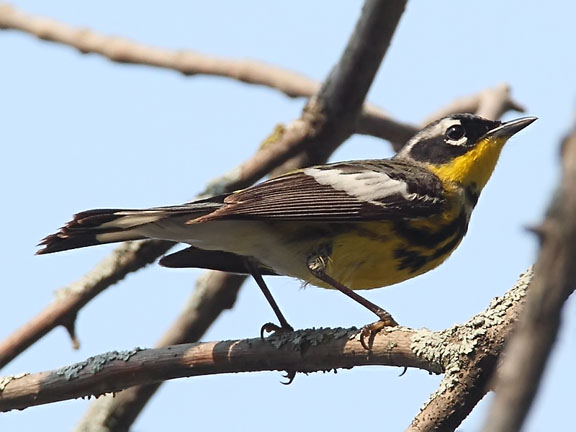 I saw many different types of warblers besides yellow-rumps such as Nashville and yellows. Both of these types are easy to catch your eye because of their bright yellow color but you have to be careful to look closely because sometimes you can get lucky and find one of the more fancy yellow warblers like the Magnolia warbler above.
 Northern parula are not as colorful as the magnolia but I was very happy to have the chance to photograph one. As you may know, if you are a frequent visitor to Ecobirder, I do not count a bird to my life list until I have an identifiable picture. I guess that means I can now add northern parula to my list.
 While I have photographed bay-breasted warblers before this picture that I took at Crosby turned out better then any that I have taken in the past. I was lucky on this occasion too because the skies clouded up, which made taking pictures pretty difficult, with in an hour of me arriving at the park. Right before the clouds took over the sky this bay breasted flashed a quick peak for the camera. Besides those pictured I also saw yellow warblers, American redstart, black and white, blackpoll, Blackburnian, Tenessee, and palm warblers.
 This weekend I took a trip over to the T S Roberts Bird Sanctuary in south Minneapolis. The sanctuary is part of Lyndale Park and was officially designated as a bird sanctuary in 1936 by Christian Bossen, who was the superintendent of Minneapolis Parks at the time.
  In 1936 the park was originally called the Lyndale Park Bird Sanctuary but in 1947 the park was renamed after Thomas Sadler Roberts. Roberts was a retired physician who became a professor of Ornithology at the University of Minnesota. In 1932 Roberts published the book, "Birds of Minnesota" which was ground breaking at the time, and is still considered an important book for anyone birding in Minnesota.
 The sanctuary was created primarily as habitat for migratory song birds, particularly warblers. There are trails and a boardwalk that run through a variety of different habitats, wetlands, fields, and forest, that can be used as a stop over for warblers as they migrate. Unfortunately the only warblers that I was lucky enough to see on this trip where yellow-rumped warblers and a single ovenbird.
  I have visited the sanctuary a couple of times in the past. While it once may have been a hot spot for migrating birds the creation of other larger parks nearby, Fort Snelling State Park, Hyland Park, Minnesota Valley NWR, and others may have decreased the number of birds that now use the sanctuary. However it is still great habitat for many of the birds that choose to nest in the area, such as sparrows, robins, and chickadee.
 This years abundance of snow and rain has increased the size of the wetlands in the park. Several trails are still flooded over making detours necessary in some cases.
 While the excess water may make it a bit more difficult for some visitors other visitors have taken full advantage of the new wetlands areas. Mallards and wood ducks can be found swimming in low land parts of the park that are usually dry.
 The reason for my visit to the sanctuary though was the fact that there was a great horned owl pair that still had young that had not fledged. The other couple of nests that I had been watching had already fledged and were now difficult if not impossible to find. This pair of owls appeared to have nested a bit later then normal and so they still had young in the nest.
 The nest was located in the back of the park very near to a trail. The location was very good for people who wanted to get a good look at the owls, or perhaps a photo or two, but it was probably not the best location for the owls. Many people know about the nest, particularly because of its location, and stop by to gawk. The owls do not seem to mind this invasion of privacy too much except for perhaps an occasional yawn of boredom for all of the strange humans below.
 I don't think that the young ones will be in the nest for much longer though. They are already quite big. The squirrels nest that the parents confiscated, great horned owls do not make their own nests, is pretty small for the two big babies and mom. So soon it will be time for the young ones to leave the nest, and perhaps head off to college, or at least some nice mouse laden field around a college.
 On Saturday evening the rain finally stopped, the clouds began to break up and the sun made a rare appearance. Even though it was already almost dinner time I decided to take advantage of the opportunity and headed over to the Minnesota Valley NWR. I was hoping to have a chance to photograph some warblers. We have been seeing yellow-rumped warblers for over a week but reports were starting to come in about other warblers in the area.
 Taking pictures of warblers can be very tricky, because of their small size and constant movement. Fortunately the trees here have not yet begun to leaf out which makes it a bit easier to find and photograph them, but as you can see in this picture of an orange-crowned warbler the trees will be spreading their new leaves soon.
 One of the more rare warblers that I spotted was this black-throated green warbler. He was searching a pine tree for insects when I came down the path. I did have to turn up the ISO to get a picture in the low light, which is why it is not the best picture, but I was just happy to see one this year.
 This Nashville warbler was high up in the tree tops. It did not seem very concerned about the strange guy with the big camera below it. It may have just come in that night, warblers typically migrate at night then spend the day foraging for food, and was hungry for a long flight.
 The best shots that I got were of a black and white warbler. I have taken black and white warbler pictures in the past but they usually do not turn out very good. This time the bird was pretty close, traveling up a tree trunk the same way that a woodpecker or nuthatch would, and in good light which helped me to get my best black and white photos to date.
 There were also other birds around. Down at the ponds there were several types of ducks. Along the shore great egrets and a solitary sandpiper were wading through the water in search of dinner and rustling through the leaves I found a lot of white-throated sparrows.
 Yesterday turned out to be a fabulous day weather wise, so I decided to go out and take some pictures before an afternoon dinner with Michelle's family. Since my time was limited I decided that it was best to stay in the Twin Cities so I went out to check on some of my favorite haunts including Wood Lake Nature Center. The visitors center was closed due to the holiday, but the park was open and occupied with quite a few visitors.
 I was encouraged to see quite a few signs of spring. Insects have begun to spring up now that the weather has gotten a bit warmer. There were already plenty of flies and box elder bugs flying around. A few green darner dragonflies had completed their northern migration and were chasing the small flying insects in the fields and mourning cloak butterflies were warming their wings in the sun. Mourning cloaks over winter in their adult butterfly form, that is why they are usually the first butterflies that you can see in the spring. Soon they will mate and then pass from the world making way for their offspring.
 The first warblers of the year have also arrived. Yellow-rumped warblers seem to be everywhere. Warblers are typically insect eaters so they do not usually return until after the bugs do. Since yellow-rumps do not typically migrate as far south as most other warblers they are usually the first to arrive in the spring, as well as the last to leave in the fall.
 Canada geese have already begun to nest. They usually nest on islands of reeds in the middle of the lake. This gives the nest some protection from predators like fox and coyote. Then they use many of their own down feathers to line the nest, making a soft feathery bed for the eggs.
 Much of Wood Lake Nature Center is occupied by Wood Lake and adjacent wetlands. The lake itself is very shallow, only a couple of feet deep in many locations, and has a boardwalk running through the middle of it.
 There are wood duck houses that have been placed around the lake, as well as in some of the parks other water features, to provide nesting habitat for cavity nesting ducks such as Wood Ducks. Because the correct habitat is carefully maintained it is possible to see wood ducks in the park almost any time that you want to visit.
  It is not only wood ducks that take advantage of the wood duck nesting boxes though, hooded mergansers are also cavity nesters and frequently will take over nest boxes in the park. During mating season both male and female can often be seen floating on the lake but later on in the summer the males will move off leaving the female to raise the family.
 The turtles were also out enjoying the sun and the warm weather. Turtles are reptiles and as such are cold blooded. So they rely on the sun to warm them up which helps them to move better, digest food and fight diseases. They use logs, rocks, or any other make shift platform to bask in the sun, often piling on top of each other, or staking, in order to get more sun.
 With dinner time approaching I decided to make my way back to the parking lot. On my way I noticed this great egret flying across the beautiful blue sky. I think that perhaps he had the same idea and was heading off to his in laws for dinner, but I doubt that it was ham and German potato salad.
 One of the first warblers that we see here in Minnesota each spring and last ones that we see in the fall is the yellow-rumped warbler. This is because they have a more northern winter range then most of the other warblers, stretching as far north as northern Indiana and Illinois.
 One reason that they can survive in harsher northern climates may be the fact that they are more of a generalist, when it comes to eating, then many other types of warblers. They eat plenty of insect, and will often catch them in the air, but they will also eat seeds and berries when there are no insects available, including wax myrtle and bayberry which they can digest and other warblers can not.
 Near the end of September, 9-29, I made a quick stop at Maplewood. I did not have much time, as the skies were clouding up and were threatening to rain on me, but near the boardwalk that crosses the lake I found a small group of yellow-rumped warblers skittering from lily pad to lily pad searching for bugs to eat.
 Yellow-rumped warblers are one of the most common warblers that we see here in Minnesota during the migration period. They are able to digest bayberries and wax myrtles, which other warblers can not. This provides them with an additional food source that other warblers do not have which enables them to winter further north.
 Some yellow-rumped warblers winter as close as northern Illinois and Indiana. Because of this they are usually one of the first warblers to migrate through in the spring and last to migrate back through in the fall.


