Last week while I was chasing after the black-bellied whistling duck, a rare visitor to Minnesota, reports of another rare bird where flooding the
MOU list server. An Inca dove had been spotted by Jim Lind up in Two Harbors, MN. This was the first Inca dove ever reported in Minnesota so most of the Minnesota birding community was very excited. I could not make the trip up to Two Harbors, which is on the north shore of Lake Superior about 20 miles north east of Duluth, during the week because of work and my volunteer responsibilities. So I planned to drive up Friday after work and stay over night.
I arrived in Two Harbors on Friday at about 4 pm. I quickly found the neighborhood where the dove had been hanging out, it was just a couple blocks north of the light house. The dove had been seen in a residential area feeding on seed under feeders between about 5 houses. Fortunately all of the yards that the dove was visiting could be viewed from an ally or the street, so that no one had to disturb any ones private property to see it. That was a good thing considering how many birders were making the trip to see the bird. I was not alone in my search there were 4 other birders also poking around.
On Friday night we spotted a dove hanging out with the neighborhood pigeons that looked like the right color and had a scaly look to it. We thought we had the birds in our sites but on closer examination we found that it was actually a very scruffy mourning dove.

This mourning dove did not look like your typical mourning dove, with it's feathers all
poofed out, but the tail was pointed and not square, it had markings on the wings, and it was the wrong size and had the wrong eye color so we knew that it was definitely a mourning dove and not the Inca dove. Later on one of the birder found the Inca dove in the evergreens at the house on the corner but before I could get a focus on the area it took off and went into a tall spruce tree where it were Jim believed that it had been roosting most nights. So I left and went and found a hotel to stay the night. The next morning I got up early and went down to the shore of Lake Superior, near the light house, to take some pictures of the sun as it rose over the big lake.

After it got light enough to shoot, shortly before 9am, I headed back to the houses which the dove had been spotted. I found the dove on the ground feeding at the corner house.

I got a few Pics before it flew back into the evergreens. I then went down to the small park over by the light house. I did some birding down there, which I will post later, and then returned back to get more pictures of the dove. This time the bird was perched in a mountain ash at the 5
th house of the block which belongs to Jim Lind, the person who first spotted it.
I almost missed it, another birder had told me that it was in the tree but when I got there I saw the mourning dove perched there.

Actually both birds where perched in the same tree but the mourning dove was in front, with the Inca dove not as visible because it was further back, and so I thought that the other birder had made the same mistake that we had made Friday night. When I found the Inca dove further back in the tree it was easy to tell the difference between the two.

Several other birders came while it was perched in the tree and I was happy to help point out its location. Even a couple of local people, who were not birders but had seen all of us crazy birders walking around, came and asked me what was going on.
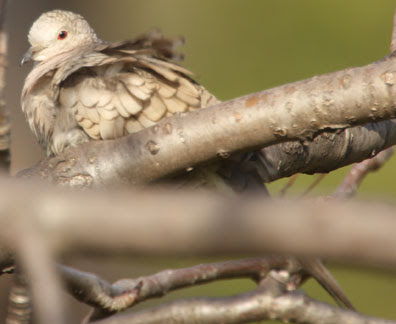
I showed them the bird and told them about how rare it was to see one in Minnesota. Even though they were not birders they were excited and talked about how they were going to tell there friends how they had seen this rare bird.

Many of the people who I were watching the bird with me had made the trek up from the Twin Cities, like I did, and most were not disappointed by the bird who was pretty good about staying in the area for over a week and cooperative about posing where we could all get good looks. After a sitting in the tree for quite a while the dove moved back down to the ground to get some more seed to eat.

I took a couple more pics of it on the ground and then headed back down to light house point to try and find a black backed or three toed woodpecker.

 Mourning doves are fairly common through out most of North America in one season or another, which is why I do not often stop to photograph them, but this bird was sitting beautifully in perfect light. So I stopped to take the pic. Mourning doves are considered a game bird and their are hunting seasons for them in many states. Fortunately Minnesota does not have a mourning bird season, I am not sure if Wisconsin does or not, which is good because I think that hunting mourning doves is one of the stupidest things that I have ever heard of. I am not a hunter, never have and never will, but at least with duck, pheasant, or dear you are hunting something that you can eat. After killing a mourning dove are you going to take it home and make yourself a sandwich?
 Many eastern kingbirds spend their summers in the area feasting on insects. When they arrive in the spring they claim a breeding territory which they defend aggressively against other kingbirds as well as larger birds such as hawks, crows and bluejays. In the winter they migrate down to South America where they live in communities and eat mostly fruit.
 The killdeer is the most common shorebird that we usually see in the area. That is because they have adapted well to people. This killdeer was searching the dirt road for worms, grasshoppers, beetles and other insects. Killdeers are great actors and will put on the show of a lifetime, pretending to have a broken wing to lure predators away from their nest.
 Ring-necked ducks are named so because of the rust colored ring on their necks. Typically you do not get to see the ring, but this duck has his necked stretched so that the ring is visible. I wonder if this is the same ring-necked pair that I photographed earlier in the year at Crex that was also showing of its ring.
 One of the birds that is most identified with Crex Meadows is the Sandhill Crane. Crex has a resident population of sandhills which comes each spring and stays though until fall. Last year Michelle and I were lucky enough to get to photograph a sandhill colt but this year I was not so lucky.
 In the fall more sandhills will arrive at Crex from all around the upper Midwest and Canada. Hundreds of cranes will be grouped together preparing for the flight down to their winter habitat. Winters are spent in Texas, New Mexico, and Mexico with small populations also in southern California and Florida. In the spring tens of thousands of cranes migrate together all stopping to rest at the Platte River in Nebraska. From there they break up into groups and move on to their summer breeding ground.
 The only raptor that I photographed that day was this bald eagle who was keeping a watchful eye over the park. From what I have been told, at the National Eagle Center, Wisconsin is the state with the fourth largest population of eagles in the US, first being Alaska, then Minnesota and Florida.

