Showing posts with label green darner. Show all posts

Sunday, April 1, 2012

Green Darner

green darner dragonfly While I was out this afternoon I spotted my first dragonflies of the year. I spotted over a half a dozen green darners patrolling the water at the Minnesota Valley Refuge. The green darner is usually the first dragonfly that we see each year because some of them migrate south in the fall. This is not a full migration like birds do, the darners life span is not long enough, it is a partial migration similar to monarch butterflies. The dragonflies head south where they mate, lay eggs and then die. The eggs hatch into underwater nymphs. In the green darner it only takes about 3 months before the nymphs are ready to emerge and become dragonflies. Some of these newly emerged dragonflies head back north where they will mate and then lay eggs and die. Their offspring will be emerging at the end of summer just in time to migrate south. This year they seemed to have arrived a bit earlier then most years probably because of the early spring and mild winter we have had this year. I did not get any pictures of those that I spotted today. At this time of year they spend a lot of time hunting and rarely stop to pose for photos. This pic was taken in the refuge in the summer

Wednesday, March 2, 2011

Wednesday, November 24, 2010

Sunday, July 25, 2010

Green Darner Dragonfly


This summer I have been spending a lot of time participating in events sponsored by the Minnesota Odonato Survey Project. MOSP is a small group that is working on surveying and recording all of the different species of Odonates that are present in each county of Minnesota.

Very little data has been collected over the years on what Odonates, dragonflies and damselflies, can be found in Minnesota and where. The MOSP is working to resolve this issue by teaching people about odonates, so that there will be more people collecting data on them through out the state. Last week I drove about 5 hours each way to participate in the MOSP event up at Voyager National Park. Even though it was a long drive I specifically wanted to participate in the event at Voyager because it is very different habitat from where I live. I was rewarded by photographing several species that I did not have pictures of before.
Green darners, as seen in this series of photos are common through out much of North America. Each year the last brood of the green darners that emerge head south to avoid the on coming Minnesota winter. When they reach their warmer destination they mate and lay eggs, egg laying is pictured in the two photos above, and then they die. The eggs hatch and the larva spend a few months in the warm waters before they emerge as green darner dragonflies and begin to fly north. That is why the green darner s one of the first dragonflies that we see each spring. This weekend I will be heading out again to Dragonfly Weekend where I hope to have the opportunity to photograph a few now dragons.

Sunday, April 25, 2010

First Dragonflies of the Year: Green Darner

Last week I spotted my first dragonflies of 2010. They were green darners of course. Some green darner dragonflies actually migrate south, sort of like birds or monarch butterflies. Their migration is a little bit different though. Unlike birds or monarchs the green darners that migrate south reproduce and lay eggs when they reach their southern destination and then they die, as most dragonflies and butterflies do shortly after laying their eggs.
The eggs hatch into the larval form of the dragonfly in the warm southern waters over the winter months and then emerge as dragonflies in the spring. These dragonfly then head north, which is why they are usually the first dragonflies that we see each spring. When they reach their northern destination they will mate, lay eggs, and then die. Their offspring which emerge in early fall will then migrate south again beginning the circle once more. This dragonfly was a fresh emergent last August. You can tell that she had recently emerged by how shinny her wings are. She landed in this evergreen to dry her wings before she would take off into the world which made for a great macro opportunity.

Sunday, December 20, 2009

Maplewood Dragonfly Workshop

When I began this blog my subjects were mainly birds with a few mammals that I photographed mainly while we were on vacation. After a while I found myself getting kind of bored in the middle of summer because I was mostly seeing the same types of birds each time I went out.
That was when I began to photograph other things that I found interesting. At first it was butterflies, which seems to go natural with birds, but then I started getting interested in dragonflies like the big green darners featured in the photographs above.
I remember catching dragonflies by the tail in the long grass when I was a kid but I did not really know a lot about them. So I started reading about dragonflies on the web and came across the website for the Minnesota Odonata Survey Project. I found a lot of good info on Minnesota dragonflies on their site and also found that they sponsored some workshops. So I took my first dragonfly workshop in August of 2008 at the Maplewood Nature Center. By this time I already knew that I had really been catching damselflies, like the one above by the abdomen when I was a kid.
Damselflies are typically smaller then dragonflies, however some of the larger damsels are bigger then the small dragons. All four of the damselflies wings are the same size and shape where a dragons hind wing typically differ in size and shape from the forewing. When perched damselflies will hold their wings together up over their abdomen while dragons rest their wings out to the side. The exception to this are the spreadwing damsels that rest, as their names suggest, with their wings spread. The photo above is a slender spreadwing damselfly.
Damselflies also have separated eyes, like this spotted spreadwing. Most dragonflies have eyes that touch each other at some point. Again there is an exception to this rule because clubtail and snaketail dragonflies also have separated eyes. All of these photos were taken at the dragonfly workshop in August 2008.

Sunday, October 25, 2009

Common Green Darner

Once in a while you get lucky and find one of the larger dragonflies shortly afer it has emerged. At this point in their life cycle they usually have to spend time perched, so that their wings can get into shape, which gives you an opportunity to get some real close close ups. I photographed this common green darner in Como Park.

Sunday, September 6, 2009

Darner Dragonflies

I spent most of today volunteering at Hawk Ridge up in Duluth, MN. As always I brought my cameras with and got some fun pics but for those you will have to wait for tomorrow. Most of the birds that we saw today up at Hawk Ridge were the smaller raptors; sharp-shinned hawks, kestrels and merlins. These birds are usually the first types of raptors that begin migrating south in the fall.A big reason that many of these birds begin to migrate, particularly kestrels and merlins is because they are following the migrating green darner dragonfly. The green darner migrates a lot like the monarch butterflies do. They head south in the fall to warmer climates where they will lay their eggs and then die. The offspring hatch and mature quickly, with in about three months, then they begin to head north and spring begins. Once they arrive back in the north they will lay eggs and then die and their offspring will begin the process again. There are many other types of darner dragonflies other then the green darner. There are 39 species of darners in North America and 500 different types of darners world wide. There has been very little study on migration for these other types of darners, but since most of them emerge later in the summer it is probable that they die when the winter cold arrives.
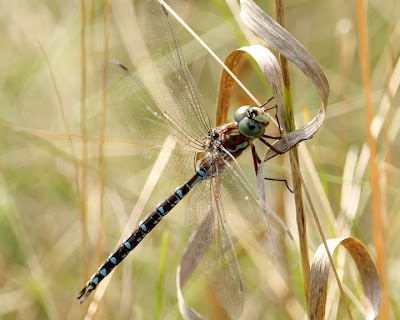
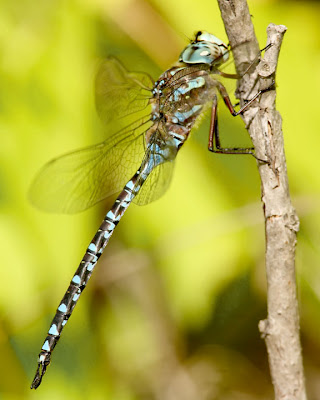
The darners are sub divided into several different genus. The largest genus are the blue darners. All of the blue darners, genus Aeshna, have two side stripes on their thorax. People who study Odonata, dragonflies and damselflies, use the shape, size and color of these side stripes to distinguish between the different types of blue darners.
From the shape of the side stripes I believe that this is a Canada darner. Canada darner are pretty common in my neck of the woods. They prefer a habitat with a lot of vegetation mixed in, like small green ponds, slow moving streams or the marshy shores of lakes. You can usually find them flying from the beginning of July through September, although I find that they are a lot easier to photograph in September. I have just begun to start to see blue darners around here this year, these pictures where taken at Carpenter Nature Center in September of 2008.

Thursday, May 1, 2008

Green darner in Flight.

On April 21st I stopped at Dodge Nature Center on my way home from work to do some birding and take some pics. I did get some bird pics, which I will share on my next post, but I was more excited to get my first dragonfly pics of the year.
I have been seeing quite a few common green darner dragonflies on my adventures as the temps have increased. Green darners are large dragonflies that are strong fliers. I typically see them flying over ponds or fields on the hunt for mosquitoes or other small flying insects. The difficulty with photographing green darners is that they often fly for a long time, and they can fly for quite a distance, so finding one that has landed can be difficult. Even though this darner did not land for me I got lucky and it decided to do some hovering. It took me a while to get it in view and get the lens focused before it moved, especially since most of the work that I do is using manual focus, but eventually I was able to get some pics of the darner in flight.
Green darners are very similar to birds in many ways. These dragons migrate south much the same way that many birds do. In fact researchers at Princeton found that they exhibit some of the same traits that birds do when they migrate, such as migrating during a cold front with favourable north west winds or skirting large bodies of water during migration. Now they have returned to their summer breeding grounds and they are hunting for food and soon they will begin mating, much the same way that migrating birds are.

Monday, October 15, 2007

Birding the Black Dog Unit of Minnesota Valley NWR

Sunday morning (Oct 7) it was still sunny out so I headed out to the Black Dog Unit of the Minnesota Valley NWR. I parked at the River Hills Drive entrance, which is on the west side of the park, and headed north on the trail. Right before the trail took me into deep woods I spotted a red-tail circling in the sky over the lake. Once I was in the woods I spotted quite a few sparrows, warblers, robins and chickadees. Unfortunately it was too dark, in the woods to get many pictures.
At one point the trail led out to the railroad track. A ways down the tracks I spotted a couple of wild turkeys crossing. In the tall grass next to the tracks I spotted a green darner landing so I snuck in and got a couple of shots.


I could tell that this one was a female by it's red abdomen. Since I was in the open I noticed that the sky had begun to cloud up. Since I did not have any rain gear for the camera I decided to turn back and drive to the other side of the lake. By the time I got down to Black Dog Road the skies where threatening rain so I decided to drive around the lake and see if there was anything that I could get pictures of from the car. While I was going past the power plant I noticed a double-crested cormorant perched high in the trees on the side of the river.Further down Black Dog Road I found a spot that I could park where there was a field next to a channel that allows water from the river to flow into the lake. It was not raining yet so I decided to explore. There were a few sparrows around and about a half a dozen cormorants in the lake. I was chasing a clouded sulfur around trying to get a picture when I caught sight off a pearl crescent butterfly. The crescent was a lot more cooperative then the sulfur who was fluttering around like a toddler on a sugar high.Shortly after I got back to the car it began to lightly rain so I decided that I would prolly not get any more pictures so I headed home.

Wednesday, October 10, 2007

Other interesting things that I found at Crex Meadows

On my last trip to Crex Meadows I photographed a few interesting things that were not birds. First I found this banded woolly bear caterpillar walking down the road. Woolly bear caterpillars hibernate over the winter. It is estimated that they can survive temperatures down to -90 degrees. They survive in extreme cold because of their bristly hair and because they produce a type of anti-freeze coating. At this time of the year they are probably looking for a good place to hibernate, usually under a log or a rock. In the spring time they wake up from hibernation, eat for a couple of weeks and then spin a cocoon. A few weeks later they emerges from the cocoon as an isabella tiger moth.

I also found a perched green darner dragonfly. You can tell that this one is a female because her abdomen is red. Males have a blue abdomen where females can have either a blue or red abdomen.It was a beautiful day so it was no surprise to find a few turtles out sunning themselves. You can almost always see them out on rocks, logs, or the shoreline on a sunny day.The highlight of this trip was spotting a river otter. I new that there were otters in the area but this is the first one that I have spotted in Crex. It is actually the first that I have spotted in this part of the country.Otters are very fun to watch. They are often curious and sometimes even playful. In the past I have photographed river otters in Yellowstone National Park and in Big Cypress National Preserve, down in Florida. I have photographed sea otters in Monterey Bay, CA and up in Alaska.

Thursday, October 4, 2007

Green Darner at Wood Lake Nature Center

Yesterday it was a beautiful day so I decided to visit Wood Lake Nature Center after work. It is hard to believe that it is already October, especially with the weather as nice as it was yesterday. The sun was shinning, there was a pleasant breeze and the temp was in the upper 70s. Out in the open fields at Wood Lake there were still many dragonflies and butterflies flying around. Living in Minnesota all my life I remember many years in the past that we have had snow which stays on the ground in October. So it is pretty strange, and very cool, to still see insects flying around.

I got really lucky yesterday in that I managed to find a green darner male that had landed in the grass. Green darner are one of the big green dragonflies, some of them are bigger then humming birds, that you usually see zipping by. Green darners are very strong fliers so they spend a lot of their time in the air. When they do land they blend into the brush pretty well so that you usually do not see them until it is too late and they have taken off. But yesterday I spotted this green darner male as he was flying low over the grass and watched him until he landed. Then I crept slowly and carefully until I was close enough to get some great pics. Her he is in the grass.


You can tell that he is a male because he has a blueish abdomen. Here is a close up of his face.


I also spotted a saddlebags in flight but unfortunately he did not land. I did also get some bird pics before I had to go to my meeting at the Raptor Center but I will have to share them with you later.

Sunday, August 5, 2007

Green Darner

On Sunday July 29th I shot this picture of a female green darner dragonfly at the Blackdog unit of the Minnesota Valley NWR. Green darner are pretty easy to identify by the target like mark on the top of the head. You can see a little bit of the blue on the top parts of the target.
This green darner is a female. You can tell by the color of the tail. Male usually have blue tails where the female's tail is usually green or reddish-brown. She stayed in one spot and let me take quite a few photographs. I even took the time to switch between my 100-400 telephoto to my 100 2.8 macro lens. Maybe she stayed so long because her color blended so well into the bush which she was resting on. For more information on green darners and other dragonfly check out this site http://www.cirrusimage.com/dragonflies.htm