


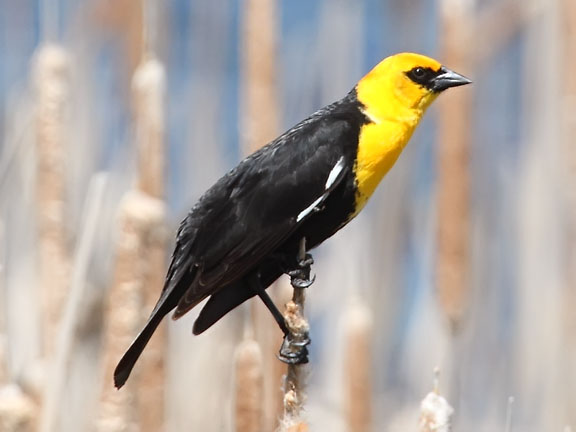
 In all of the alphabet there are only a few letters that are difficult for me to find a picture to represent. X is one of those letters. Fortunately it is a bit easier to find a scientific name that begins with an X. Xanthocephalus xanthocephalus is the scientific name for the yellow-headed blackbird. The yellow-headed blackbird is more closely related to meadowlarks then it is other blackbirds that is why it is in its own genus Xanthocephalus instead of Agelaius or Euphagus like most other blackbirds.
 The yellow-headed blackbird breeds in the western United States and up into Canada. They inhabit prairie wetlands and cat-tail marshes. The nest is cup shaped and usually attached to the vegetation. Yellow-headed blackbirds nest communally. They typically also nest with in the same habitat as red-winged blackbirds. Since the yellow-headed black birds are larger then the red-winged blackbirds they usually get the better nesting spots. Yellow-headed blackbirds migrate down to the south western United States and Mexico for the winter.
 The yellow-headed blackbird is medium sized blackbird that breeds in the wetlands of western North America. They often breed in the same wetland as red-winged blackbirds but because they are larger they will often force the red-winged blackbirds out of the best nesting locations.
 Male yellow-headed blackbirds arrive at the breeding grounds first. The come from the wintering grounds in Mexico and Central America. The male will defend his territory from other yellow-headed males as well as red-winged blackbirds and marsh wrens. The male will sing to attract females to nest in his territory. He will often mate with multiple females but he will usually only help raise the first group of nestlings. Females are much less colorful then the males. Since they spend quite a bit of time on the nest it is to their advantage to have better camouflage
 Xanthocephalus- which consists of only the yellow-headed blackbird. Even though it is called a blackbird it is more closely related to meadowlarks then it is other new world blackbirds.
 Agelaius and Euphagus- Angelaius consists of the tricolored blackbird and red-winged blackbird. While Euphagus is closely related to grackles and consists of the Brewer's blackbird and the rusty blackbird.
 Dolichonyx- consists of just the bobolink which combines characteristics form multiple other genera.
 Molothrus- consists of the cowbirds including the brown-headed cowbird, shiny cowbird and bronzed cowbird. All three species are parasitic nesters, laying their eggs in the nests of other birds and leaving the other birds to care for the chicks.
 Quiscalus- grackles, including the common grackle, great-tailed grackle and the boat-tailed grackle. Grackles are larger then blackbirds with larger bills and a longer tail.
 Sturnella- which consists of the eastern and western meadowlark. It is difficult to distinguish the difference between these two species in the field. If I was better at my bird calls I would probably have an easier time since most people say that their song is the easiest way to identify them.
 Icterus- These are the Orioles including streak-backed, Bullock's, Baltimore, hooded, orchard, altamira, spot-breasted, Audubon's and Scott's orioles. These are the most colorful of all of the Icterids found in North America.
 After my visit to Tamarac NWR I headed over to the Prairie Wetlands Learning Center in Fergus Falls to participate in a Minnesota Odonata Survey Project event. The morning started out with some showers and thunderstorms but by afternoon the sun was out and shinning.
 The Prairie Wetlands Learning Center is a cooperative venture between the US Fish and Wildlife Service, the Minnesota DNR, and the city of Fergus Falls. It is the first residential environmental education center that is operated by the US Fish and Wildlife Service.
 The center began as the dream of local conservationists in the Fergus Falls area. A grass roots effort began in the 1970s to create a facility, that was open to the public, that would focus on prairies and wetlands. In 1989 they formed the Friends of the Prairie Wetlands Learning Center to help to accomplish their goal.
 Through a combination of private donations and public grants they eventually were able to fund the creation of the center in 1994. In 1998 they expanded by adding a visitors center and dormitory. In 2008 they expanded again and added an education wing which included six classrooms and a multi-purpose meeting room.
 The center is a part of the Fergus Falls Wetland Management District and includes 330 acres of native and restored prairie, 28 wetlands, oak savannah and 3.5 miles of trails. Over 180 bird species have been identified on the property including the yellow-headed blackbird and purple martins pictured in this post.
 Unfortunately I did not see any new and exciting dragonflies, however there were some cool insects around for me to photograph. Two of the cool new insects that I was able to photograph were the Virginia tiger moth and the yellow garden argiope spider pictured above.
 Yellowstone in May is not exactly a birders paradise so we typically arrange another stop or two, while on vacation, to do a little bit of birding. This year we left Yellowstone a day early so that we could visit a couple of other parks on our way home. Unfortunately due to bad weather and a flat tire we only had the opportunity to make one stop.
 Bowdoin National Wildlife Refuge is located in the short and mixed grass prairie region of North-central Montana. It is home to many western prairie species of birds such as the western kingbird and western meadowlark, pictured above.
 Bowdoin was established back in 1936 to help protect vital resting, feeding and breeding habitat for migrating birds, particularly waterfowl and shorebirds. The refuge encompasses 15,551 acres, 8,675 of which is wetlands. The wetlands provide homes to a variety of birds such as the yellow-headed blackbird pictured above.
 The refuge is centered around Lake Bowdoin. In preglacial times it is believed that the lake was actually an Oxbow in the Missouri River but over time the river has moved 70 miles south of the lake. What was left behind is a variety of habitats including saline and freshwater wetlands and native prairie. These are perfect habitat for the marbled godwit pictured above.
 Before 1936 Lake Bowdoin was used by the Montana Bureau of Reclamation as a catch basin to help manage the waters of spring floods, irrigation return flows and seepage. Each spring snow melt would pour down into the lake from Beaver Creek and the Black Coulee drainage flooding the land around the lake. This provided good habitat for shorebirds and waterfowl that were migrating north at about the same time, like the white-faced ibis flying above.
 Once the refuge was established the Works Progress Administration began the construction of the refuge headquarters as well as a system of water control structures designed to help manage the wetlands to provide the proper habitat for waterfowl and shorebirds like the Wilson's phalarope pictured above.
 Lake Bowdoin sits on 5,459 acres of the refuge. Islands in the lake hold breeding colonies of white pelicans, double-crested cormorants, California and ring-billed gulls. Wetland areas around the lake provide habitat for American avocet, black-necked stilts, ducks and grebes. Eared grebes in breeding plumage are a common site at this time of year.
 In the upland prairie areas you can find pronghorn antelope, deer, sharp-tailed grouse and raptors. We found a pair of northern harriers hunting in the fields just outside the refuge. I was happy to get a shot of the mail in flight. I see females pretty frequently around home, mostly during the fall, but I hardly ever see the males. Female harriers are mostly brown compared to the light gray color of the males from which they have received the nickname, "the gray ghost".
 On my way back home from the Detroit Lakes Festival of Birds I decided to make a stop at the Prairie Wetlands Learning Center located near Fergus Falls, MN. I had the option to visit the center on one of the festival field trips but I choose Itasca and Tamarac instead because the Prairie Wetlands Learning Center was an easy stop on my way home.
 The Prairie Wetlands Learning Center is the first residential environmental center operated by the U.S. fish and wildlife service. It began as a grass roots effort back in the 1970's to establish a public use facility focusing on prairies and wetlands. A local group calling themselves "The Friends of the Prairie Wetlands Learning Center," formed in 1989 and through private donations and grants they were able to open the center in 1994. The facility was expanded to include a dormitory and visitors center in 1998 and an education wing in 2008.
 The Prairie Wetlands Learning Center is located on the Townsend Waterfowl Production Area, a 330 acre tract of land consisting of native and restored prairie, 28 wetlands and an oak savanna. There have been over 180 different species of birds that have been identified on the center grounds. With the abundance of prairie habitat it is no surprise that many different types of sparrows can be found there.
 I have to confess that I have a difficult time identifying sparrows, right up there with gulls and darner dragonflies, so if I have misidentified any of these sparrows please let me know. I believe that the first sparrow, 2 pictures above, is a white-crowned sparrow, the one directly above is a clay colored sparrow and the one below is a song sparrow.
 One of these days I am going to have to take the sparrow workshop that Doug Buri and Bob Janssen put on out in western South Dakota. I took their shorebird workshop back in 2008 but have not had the time to get out to take the sparrow workshop in October. Last year they identified 14 different species during the three day workshop. If you are interested in this workshop here is the address where you can find more information.
 Besides sparrows there were other birds like this eastern bluebird. Bluebirds seem to be more common these days. That is just my unscientific observation.
 Another cool bird that I was able to photograph were purple martins. I have seen purple martin gourds at several different locations but usually there have not been any purple martins. At this locations there seem to be a healthy population.
 Besides the prairies the Prairie Wetlands Learning Center also has wetland areas. Around the wetlands I found quite a bit of bird life, such as Canada geese, mallards, American coot, as well as redwing and yellowheaded blackbirds.
 While I was on my way back to the car everything went quiet. All of the small birds seemed to just disappear leaving me with just the Canada geese and mallards. A shadow crossed over head and I looked up to see a coopers hawk crossing the sky in search of prey. Since the geese were a little much for a coopers hawk it continued on its way.

