


 Every year for a few weeks in the spring and a few in the fall warblers migrate through the area. This is usually one of the most exciting time of the year for a lot of the birders, since most everyone loves the colorful warblers. Unfortunately it does not usually last all that long and before you know it most of the warblers have moved on past us. Fortunately their are a few species that seem to hang around most of the summer.
 The American redstart is one of the most common warblers that breeds in our area. Mature males are red and black in color while female and immature males are yellow and gray like the bird pictured above. I usually spot redstart fluttering from branch to branch looking for insects to eat, which they often catch on the fly. I photographed this redstart up at Park Point in Duluth back in September.
 We returned to Wild River frequently over the next few years but as I learned of other places to bird our trips there decreased. I did make one trip to Wild River in August (8-24) of 2008 and I saw a few interesting birds. There were a few cedar waxwings travelling up the shore of the St Croix, probably searching for berries to eat.
 The American redstart is a wood warbler that usually hangs around southern Minnesota around the summer time instead of heading further north. Like most warblers they are insect eaters which is a good thing to be around Wild River where there are a lot of insects, don't forget the mosquito repellent if you visit.
 The most exciting bird that I found on this trip was this scarlet tanager. Scarlet tanagers are not uncommon in Minnesota, except in the winter, but since they often stay near the tree tops they are sometimes difficult to find and even harder to photograph.
 This tanager was in the middle of molting from his summer breeding colors to his winter coloration. Males in the breeding season turn a bright red with black wings. In nonbreeding plumage the male looks similar to the female and is olive green in color.
 Scarlet tanagers spend their winter down in South America. While they are down in South America they will forage with flocks of other types of tanagers and flycatchers.
 The small trees that line the trail make for good habitat to search for warblers during the spring and fall migrations. During the summer you can still find a few warblers hanging around, usually yellow warbler or common redstart, as in this case.
 You may expect a bird that is called a redstart to have some red coloration to it. This is true with the male of the species, which has reddish feathers on its wings, back and tail, but the female redstart, pictured here, has yellow color instead of red.
 They use these colored feathers on the wings and tail by flashing them to startle insects. When the insects flush the redstart is there to reap the rewards.

In June I found several redstarts nesting by the Old Cedar Avenue Bridge in the Minnesota Valley NWR. The female redstarts are less colorful then the males which makes them a bit harder to find. This female was carrying feathers probably for nesting material.
 The nest is cup shaped and usually made of grass, bark,leaves, sticks, moss, feathers, and spider webs. The nest is fitted between the branches of a tree or large bush located in a wet deciduous forest with plenty of bushes for hunting insects.
 During the winter these birds migrate south, most ending up in southern Mexico or South America, although there is a small percentage that will winter in southern California or Florida
 I was really disappointed not to have my new lens, I have become spoiled very quickly, with so many warblers around. The AF with my old 100-400mm lens does not pick up small birds very well so I am often forced to use manual focus which does not work very well with small darting birds like warblers. So the pictures did not come out as well as they would have if I had brought the new lens. I followed this black and white warbler from tree to tree but was only able to get a few marginal pictures like the one above. I love how the black and white warblers act a lot like nuthatches, although I have not seen them walking down the tree like nuthatches like to do.
 This magnolia warbler did not come out as well as I would have liked either.
 The American redstart was a little more cooperative and gave me enough time to get a good focus.
 Besides warblers there was also a few Baltimore orioles.
 Although I am not sure who was watching who?
 The fun part of shooting that night was the newly hatched goslings
 I spotted 3 different pairs of Canadian geese with goslings. each had a clutch of 2 to 4.
 When photographing something as cute as young goslings I guess it does not matter what type of lens that you use.
 Too bad they have to grow up. The goslings are cute but adult geese can become a nuisance.
 One of the adults decided that it did not want me taking any more photos of the babies and it started to hiss at me. It is all bluff and bluster, since there is not much that a goose can do to hurt a person, but I did not want to stress them so I headed home to pack. I guess that the goose did not want its little goslings to be stars but it was already too late. Anything that cute will always draw attention.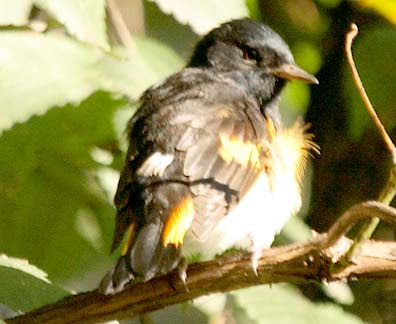
I found this scruffy american redstart at the start of the trail that followed the creek. There where a couple of white-breasted nuthatch in the trees over by the pavilion.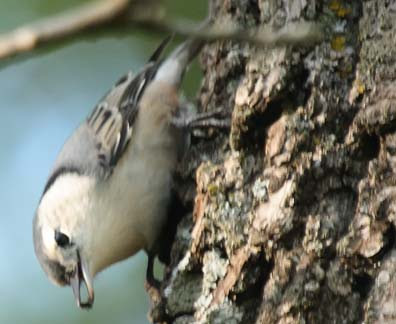
They were doing a good job of finding bugs in the trees but I was kind of wishing that they would eat some of the mosquitoes that where trying to eat me.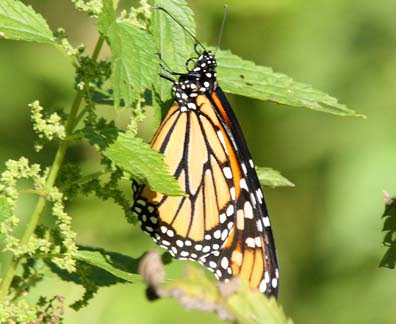
 So you may be wondering what an old bridge has to do with birding and the Minnesota Ornithologists Union, well this bridge extends through the Minnesota Valley National Wildlife Refuge. This bridge was used by many birders to get a great view of the Minnesota river flood plains and mud flats before it became unsafe to use.
 Now politicians in the cities of Bloomington, who currently owns the bridge, and Eagan, which is on the opposite side of the river, as well as several state politicians have put forth a plan to tare down the existing bridge and build a boardwalk platform on the existing cement supports. The problem is that the estimated cost is $4.5 million. A large part of that cost is for the removal of the existing bridge which contains lead so that it can not be knocked down conventionally. So far the supporters of the plan have secured $1.3 million in funding but still have a long way to go. That is why 200 or more people of all types (birders, bicyclists, hikers, and families) showed up on the 14th to show our support for this great cause. At the program, which began at noon, they had speakers ranging from local and state politicians, leaders of bicycle groups, neighbors, and leaders from MOU, Minnesota River Valley Audubon, and Minnesota Audubon.
 Near the same pond I also saw this ruby-throated hummingbird.
 I also took a couple of butterfly pics like this one of a common sulfur
 and this eastern comma which looks like it had seen better days.
 When I was walking back off the boardwalk I was startled by a white tail doe. She just sat and watched me as I walked past about 4 feet away.
 This was the only deer that I saw which surprised me because on my trips to Fort Snelling State Park, which borders the park in the north, I have seen plenty of deer. It turned out to be a great morning and afternoon. I got out, did some birding and helped lend my support for a good cause.


