Showing posts with label spotted sandpiper. Show all posts

Sunday, August 18, 2013

Spotted Sandpiper

Spotted Sandpiper
 The spotted sandpiper is a shorebird that is found through out most of North America. They breed in a variety of wetland habitats as far north as northern Canada and Alaska and as far south as central New Mexico. They also breed in mountains at elevations up to 14,000 feet above sea level as long as their is a source of fresh water. During the winter they migrate down to the southern coastal areas of the United States, Central America or South America.
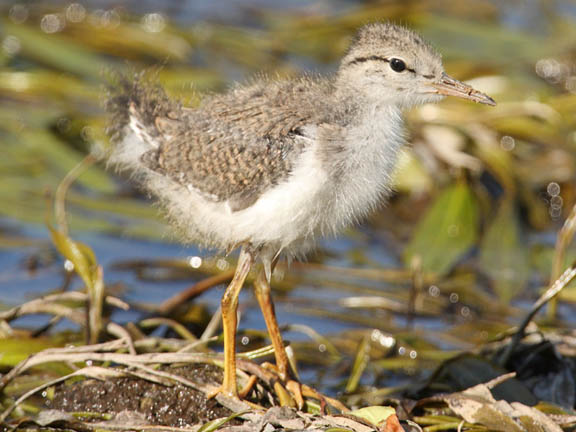
Spotted Sandpiper Chick
I found this chick along the shore of the St Croix River at Wild River State Park. At first I did not know what species of shorebird it was until I saw its parent, pictured above. Because this is a spotted sandpiper the bird in the first photo could most likely be the male. Spotted sandpiper do things a bit backwards compared to other birds. For spotted sandpipers it is the female that is first to arrive in the breeding territory and she is the one that picks out and defends a territory. Both male and female build the nest, typically as part of the courting ritual. Once the eggs are laid it is usually the male spotted sandpiper that will incubate the eggs and care for the chicks once they hatch. The female will often go and find another male and start another family.  


Tuesday, November 22, 2011

Spotted Sandpiper

The spotted sandpiper is one of the most common sandpipers in North America. They breed through out most of the northern two thirds of North America and winter in the southern United States, Mexico, Central and South America. They are solitary birds except during the mating season.
What is interesting about the spotted sandpiper is the apparent role reversal between the male and female during breeding. During the breeding season the testosterone levels in females increases by approximately seven times. She is the first to arrive on the breeding grounds and will select and defend a territory. Sometimes females will mate and lay clutches with more then one male. It is primarily the males job to incubate the eggs and care for the young once they have hatched.

Friday, September 30, 2011

Spotted Sandpiper Chick

The spotted sandpiper is the most common sandpiper found in North America. During the summer breeding season they can be found along most any type of wetlands in the northern half of the continent. During the winter these birds migrate down to the gulf coast, Mexico, Central or South America. They share the genus Actitis with the common sandpiper which is found in Europe and Asia.
One of the most interesting thing about the spotted sandpiper is that the female is the one that arrives on the breeding range first. She then will stake out and defend a territory. With other species that is typically the males role. Following through on the whole role reversal it is the male who stays to raise the young while the female will often go off to have a family with another male. So most likely this chick was raised by its father. Since the female can store sperm for about a month it is possible that it was raised by a foster father.

Tuesday, July 27, 2010

Spotted Sandpiper Watery Wednesday

The spotted sandpiper is one of the most wide spread sandpipers found in North America. They breed through out most of the northern two thirds of the continent and winter in the Southern United States, Mexico, Central America and the northern half of South America.
Unlike many other types of birds it is the female spotted sandpiper who arrives in the breeding grounds first, before the male, establishing and defending a territory. When the males arrive she may mate with more then one, leaving the male to tend the clutch while she lays eggs with up to three other males. The males will incubate and the eggs and care for the chicks once they hatch.
Sometimes a male will even end up caring for chicks that were fathered by an earlier male because females can store sperm packets for up to a month. This bird, which I photographed on the shore of the St Croix River in Wild River State Park was probably a male because I did find a chick running around.

Friday, June 4, 2010

Spotted Sandpiper

The most commonly distributed sandpiper in North America is the spotted sandpiper. These members of the genus Actitus can be found in almost any habitat where there is a water source.
Breeding occurs in the northern half of North America. The female is the first to arrive at the the breeding territory and she is its primary defender. The nest is typically built of grasses and stems and is located on the ground under vegetation near to water.
Once the female lays her eggs she will often go in search of other mates, leaving the male to perform the duties of primary parental care. The female may mate with up to four males at the same time. If she can not find a mate another mae she will usually stick around and help the male incubate the eggs and raise the chicks.
Spotted sanpiper are migratory birds. Since they eat primarily insects, both aquatic and land based, it is difficult to find food through out most of their breeding range in the north half of North America. So they head south were they look for any any habitat which has water in the southern US, Mexico, Central and South America. This sandpiper was photographed on the banks of the St Croix River in Wild River State Park

Monday, June 8, 2009

My World: Celebration Park

Another location in the Snake River Birds of Prey NCA that we stopped at was Celebration Park.
Celebration Park was established in 1989 and is Idaho's only archaeological park. The park is situated on the banks of the Snake River and was the wintering grounds for the Paiute Indians. Rock face petroglyphs, drawn by Native Americans some 12,000 years ago, are the reason why the park was established.Unfortunately we did not have very much time, only a day and a half total in Idaho, so I did not have enough time to go and photograph the petroglyphs. Instead I spent most of my time at Celebration Park doing what I usually do, photographing the flora and fauna.
The thing that I photographed the most at Celebration Park were the Bullock's orioles. This was another new life bird that we photographed on this trip.
The area was very beautiful so I did stop photographing the birds long enough to get a few scenic shots.
Another new life bird that we photographed on this trip was the California quail. We found these birds in quite a few locations around Snake River.
There were also western meadowlarks singing in the fields surrounding the park. I have photographed western meadowlarks before but since we do not see them very often in eastern Minnesota we stopped when ever one was out in the open singing to take some pics.
The river plays an important role in forming the habitat of the park. As you went away from the park the area was very dry with low scraggly vegetation. Near the river, however, it was very green with a lot more trees then could be found else where.
The river itself also provided habitat for some birds. I spotted numerous spotted sandpiper searching the shallows looking for aquatic invertebrates to eat.
There was a bridge with a walking path that crossed over the river but we were not sure that it looked very safe so we decided just to stay on one side.
But the bridge, power lines and other man made structures also helped provide habitat for the local wildlife.
There were plenty of swallows there hunting insects that used the power lines to perch and take a rest. It was interesting because there were only a few barn and tree swallows around and a lot of bank and cliff swallows. We have all these types of swallows in Minnesota but mostly I see a lot of barn and tree swallows and rarely bank and cliff swallows. So it was interesting when birders from the convention showed up and were more interested in the barn and tree swallows. I guess we kind of take for granted the birds that are common in the area that we live.