Well I am back from vacation. It has been hard to get back to my normal life after spending 9 days shooting pictures for 10to 14 hours a day. I just began to make a small dent in going through the trip pics yesterday. With 120
gb worth of pics it may take a while. I hope that you guys don't get sick of Yellowstone pics too quickly. I spent most of the day yesterday doing stuff around the house, like washing cloths, giving Misty kitten some much needed attention and then Michelle and I took in the new Narnia flick.
I do have one last group of photos that I shot the evening before we left on vacation. It was a Wednesday and it was supposed to be cloudy that day, since my new lens was already packed I brought my old lens with me to work and The Raptor Center and when it turned out to be sunny I could not help but stop off at Fort
Snelling State Park on my way home.

I was really disappointed not to have my new lens, I have become spoiled very quickly, with so many warblers around. The AF with my old 100-400mm lens does not pick up small birds very well so I am often forced to use manual focus which does not work very well with small darting birds like warblers. So the pictures did not come out as well as they would have if I had brought the new lens. I followed this black and white warbler from tree to tree but was only able to get a few marginal pictures like the one above. I love how the black and white warblers act a lot like nuthatches, although I have not seen them walking down the tree like nuthatches like to do.

This magnolia warbler did not come out as well as I would have liked either.

The American
redstart was a little more cooperative and gave me enough time to get a good focus.

Besides warblers there was also a few Baltimore orioles.

Although I am not sure who was watching who?

The fun part of shooting that night was the newly hatched goslings

I spotted 3 different pairs of Canadian geese with goslings. each had a clutch of 2 to 4.

When photographing something as cute as young goslings I guess it does not matter what type of lens that you use.

Too bad they have to grow up. The goslings are cute but adult geese can become a nuisance.

One of the adults decided that it did not want me taking any more photos of the babies and it started to hiss at me. It is all bluff and bluster, since there is not much that a goose can do to hurt a person, but I did not want to stress them so I headed home to pack. I guess that the goose did not want its little goslings to be stars but it was already too late. Anything that cute will always draw attention.


 This May I have spent a lot of time photographing warblers. The late spring helped to hold off the trees from leafing out which gave me some spectacular views at warblers that stopped on their way migrating north. One of the places that has been good for spotting warblers in Crosby Farm Park. Usually I spend a lot of my time at Crosby around the boardwalk that leads through the wetlands. Last year I got some great shots of American toads calling at this location.
 When looking for warblers however, trees are important habitat. So I decided to head out on the trail that follows the river on the south side of the wetlands. Many of the trails were still wet or full of mud due to the flooding of the Mississippi River. Fortunately we are near enough to the beginning of the Mississippi so our troubles were not as severe as they are currently experiencing down south.
 I found numerous warblers on my couple of visits to Crosby. The most common warbler that I saw was the yellow-rump warbler. Yellow-rumps are usually the first warblers that we see in the spring and the last that we see each fall because they do not migrate as far south as the other warblers. Because of the weather and lack of leaves it was not difficult to find the warblers the hard part of photographing them was separating the other warblers out from the yellow-rump, which were about 95% of the warblers that I saw.
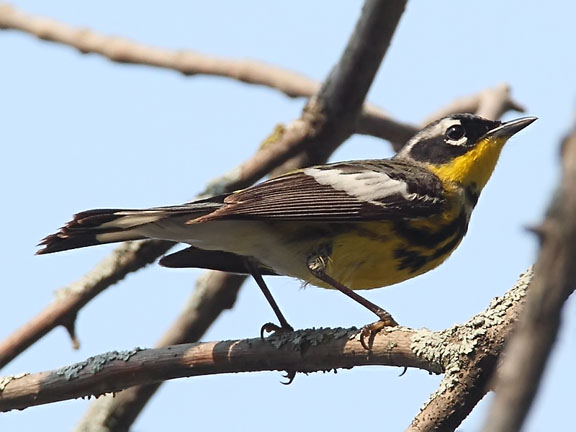 I saw many different types of warblers besides yellow-rumps such as Nashville and yellows. Both of these types are easy to catch your eye because of their bright yellow color but you have to be careful to look closely because sometimes you can get lucky and find one of the more fancy yellow warblers like the Magnolia warbler above.
 Northern parula are not as colorful as the magnolia but I was very happy to have the chance to photograph one. As you may know, if you are a frequent visitor to Ecobirder, I do not count a bird to my life list until I have an identifiable picture. I guess that means I can now add northern parula to my list.
 While I have photographed bay-breasted warblers before this picture that I took at Crosby turned out better then any that I have taken in the past. I was lucky on this occasion too because the skies clouded up, which made taking pictures pretty difficult, with in an hour of me arriving at the park. Right before the clouds took over the sky this bay breasted flashed a quick peak for the camera. Besides those pictured I also saw yellow warblers, American redstart, black and white, blackpoll, Blackburnian, Tenessee, and palm warblers.
 I was really disappointed not to have my new lens, I have become spoiled very quickly, with so many warblers around. The AF with my old 100-400mm lens does not pick up small birds very well so I am often forced to use manual focus which does not work very well with small darting birds like warblers. So the pictures did not come out as well as they would have if I had brought the new lens. I followed this black and white warbler from tree to tree but was only able to get a few marginal pictures like the one above. I love how the black and white warblers act a lot like nuthatches, although I have not seen them walking down the tree like nuthatches like to do.
 This magnolia warbler did not come out as well as I would have liked either.
 The American redstart was a little more cooperative and gave me enough time to get a good focus.
 Besides warblers there was also a few Baltimore orioles.
 Although I am not sure who was watching who?
 The fun part of shooting that night was the newly hatched goslings
 I spotted 3 different pairs of Canadian geese with goslings. each had a clutch of 2 to 4.
 When photographing something as cute as young goslings I guess it does not matter what type of lens that you use.
 Too bad they have to grow up. The goslings are cute but adult geese can become a nuisance.
 One of the adults decided that it did not want me taking any more photos of the babies and it started to hiss at me. It is all bluff and bluster, since there is not much that a goose can do to hurt a person, but I did not want to stress them so I headed home to pack. I guess that the goose did not want its little goslings to be stars but it was already too late. Anything that cute will always draw attention.
