The program is always fun and interesting. It is really cool to get to see some of their captive raptors that are not native to North America. This years foreign exchange birds included a hooded vulture, Eurasian eagle owl, tawny owl, long-crested eagle, white-necked raven and the bateleur eagle pictured above. There were also several species that are native to North America including a Harris hawk, eastern screech owl and barn owl. Three of the birds were used to demonstrate flight, the Harris hawk, hooded vulture and the barn owl, see top photo. The program helps teach CNC members and visitors about raptors and how we can help them survive, while it is also an effective fund raiser.
Showing posts with label bateleur eagle. Show all posts
Monday, March 4, 2013
Masters of the Sky
I spent most of this weekend helping out at Carpenter Nature Center. For the past 4 or 5 years CNC has hosted the World Bird Sanctuary's Masters of the Sky program the first weekend in March. The World Bird Sanctuary is located in St Louis, MO. Like The Raptor Center they began as a rehab organization for injured raptors. They still do raptor rehab but they also do raptor breeding and education program. Part of the purpose of their breeding program is releasing endangered species back to the wild while other birds are raised to help with the education.
Tuesday, February 14, 2012
Eagles
There are over 60 species of eagles in the world. Most of them are found in Europe, Asia and Africa. Eagles are members of the Accipitridae family which includes most of the diurnal raptors. Eagles are divided into three groups. The first group is the sea or fish eagles. These are eagles that have scaled legs with no feathers on them. Their legs are designed to dip into the water and catch fish. The bald eagle of North America is an example of a sea/fish eagle.
The next grouping is the booted eagles. These eagles have feathers that reach all of the way down to their feet. They are usually better hunters then sea eagles and live off hunting live prey, such as small mammals and ground birds. They often live in more arid climates and get most of their moisture from their prey. The golden eagle of North America is an example of a booted eagle.
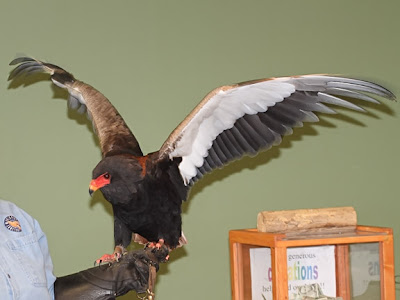
Snake owls are generally smaller then other eagles. They are usually found in Europe, Asia, Africa, and Australia. As their name implies most snake eagles hunt and eat snakes. Since many snake are equipped with venomous fangs snake eagle have extremely tough pads on their feet to help protect them from snake bites. The bateleur eagle of Africa is an example of a snake eagle.Some people also separate the harpy eagle of South America along with several other large and powerful eagles into a forth group. Many of these eagles eat larger prey such as monkeys, sloth, or lemurs which they pluck from the tree tops.
Labels:
ABC Wednesday,
bateleur eagle,
eagle,
golden eagle,
Tuesday Tweets
Monday, March 7, 2011
World Bird Sanctuary at Carpenter Nature Center
After not having a whole lot of photographic opportunities over the past month or so I was fortunate to have the opportunity to photograph several instances of the World Bird Sanctuary's, "Masters of the Sky" program this weekend.
The WBS performed 7 programs over the weekend at the Carpenter Nature Center. The first program, on Friday night, was a private program for people who are large donors to the nature center. I think that this is a really cool way for the nature center to say thank you to the people who have helped to support them.
On Saturday and Sunday they ran 3 public programs each day. Since this is the third year that the WBS has performed at Carpenter it was no surprise that all six shows were pretty much sold out. I was at six of the shows including the private show on Friday night. The show was a little different this year because this time they brought more raptors with them.
Some of the birds that they brought this year were birds that I have got to know over the past couple of years, like Tigger the tawny owl, the first pic, and Xena the Eurasian eagle owl, the second pic, but many of the birds were at Carpenter for their first visit. During the program they demonstrated raptor flight with several different birds including a barn owl, third pic, and a Harris hawk, above.
One of the birds that I thought was the coolest was Ivory, a white hawk. White hawks are an Accipiter that are found in the rain forests of Central and South America. Ivory was a victim of the illegal pet trade. She was confiscated by the government of Grenada and arrived at the World Bird Sanctuary in January of 1992. It is possible that Ivory is the only white hawk living in North America.
Another new bird to visit this year was Dezzie the hooded vulture. Hooded vultures are native to Africa so it would be a long trip if I wanted to see one in the wild.
They also did flight demonstrations with Dezzie. It was quite different to have a vulture with a six foot wingspan fly over your head compared to the Harris hawk and barn owl. All three were difficult to photograph inside with mostly fluorescent lighting but I did manage a few shots.
The third newbie was a bateleur eagle named Tsavo. Bateleur eagles are also native to parts of Africa. This was the first time that I have had the pleasure to get good photographs of a snake eagle. Eagles are divided into three families, fish or sea eagles like the bald eagle, booted eagles, like the golden eagle, and snake eagles, like Tsavo. Snake eagles have thick padding on their feet to protect them from snake bites, they like to eat snakes, so I was very interested in his feet.
The last bird in the program, and the only non-raptor was a white shouldered raven named Mischief. White-shouldered ravens are native to parts of Africa but Mischief was actually bred at the WBS. Ravens are a member of the Corvidae family and are extremely intelligent. Mischief has learned how to help take donations, a task that is easier since it is similar to food caching behavior that these birds exhibit out in the wild. Even though mischief was not a raptor his enthusiasm could be a bit intimidating for some of the smaller audience members.
Subscribe to:
Posts (Atom)

+125_2955.jpg)

