After work on Thursday I wanted to go out and do some birding but the skies were overcast and it was lightly snowing. Since I really wanted to keep my camera dry I decided to head over to the headquarters of the Minnesota Valley National Wildlife Refuge where I could watch the birds at the feeders through the windows. When I arrived around 3pm there was a small group of people there from the US Fish and Wildlife Service shooting some kind of video. They were setting up to do a shot, using the feeders outside the window as a backdrop, when the camera man pointed out that all of the birds that had been around the feeders earlier had left. I went over to take a look and he was right, the feeders were pretty much empty of birds. I began to scan the neighboring tree tops and it did not take long to find the reason for the empty feeders.

A sharp-shinned hawk was perched in one of the trees behind the feeders. I pointed the hawk out to the people who were filming who were very excited. The woman who was in charge, Valerie, was surprised that all the birds had left the feeder when the hawk arrived. She had heard that the small birds will freeze when a hawk is in the area. I explained that most of the birds probably headed for the brush when the hawk arrived and were now keeping low and still in the cover. Then I pointed out one downy woodpecker that had not gotten away quick enough and had been standing frozen for several minutes on the side of one of the feeder poles.

A few minutes later the sharpie took off and flew up over the building. I expected that all of the
passerines would return fairly quickly but the feeders continued to stay empty. I looked at the downy, who had moved to the back side of the pole where it had again stopped moving, and determined that the sharpie was still in the area, possibly on the roof. Another minute or two went by and still no
passerines came to the feeder. The downy decided to make a quick break into the woods and about 30 seconds later the sharpie flew back down from the roof to land on a branch right in front of the window.

We were all pretty excited since this time the bird was up close and pretty much in the open. It was a good thing too, because with the
cloud cover and shooting through the windows, to avoid flushing the bird, I had to open up my
aperture to be able to get any descent shots. If the bird had been further away it would have meant even less light.
The
sharpy stayed for around 5 to 10 minutes doing some preening and watching for a good meal. Since none of the
passerines were around any more he finally took of over the building. I am guessing that this might be the same
sharpy that I saw around
Thanksgiving in the same area. Maybe I will stop by on New Years Day since this bird seems to likes to visit on holidays.

I knew that the
sharpy had really left this time because with in a minute or two the area around the feeders was bustling with bird life. There where a couple white breasted nuthatch.

There were also quite a few northern cardinals.

Both male and female.

I spotted red-bellied, hairy and downy woodpeckers, like the one above. There were also black-capped chickadee, dark-eyed junco, American tree sparrow, and starlings.

 During the summer I do not pay much attention to the feeders. Instead I am usually in the small field on the east side of the visitors center looking for butterflies and dragons. Each fall or spring they burn these fields down to promote new growth but this year things did not come back very quickly due to our late winter. So I did not find very many insects to photograph. I did find a couple of eastern bluebirds, that appeared to be nesting in one of the nesting boxes that are in the field, which posed for a few shots.
 After checking out around the visitors center I decided against venturing down to the river, the trip back up the hill can be a bit strenuous when you are carrying a couple of cameras with large lenses, and decided to head down to the Old Cedar Avenue Bridge portion of the refuge. While I was preparing to go out on the trail, bathing in bug repellent, a bird flew low across the pond adjacent to the parking lot and perched on a low lying branch. I grabbed my camera and got off a shot before he flew off across the pond again in search of more insects. Even though I never got a good look at its breast, which is where many of the flycatchers have their field markings, I believe that it was an eastern phoebe, because of the dark head, white chin and black beak.


 There were also a couple of new arrivals that I have not seen in my visits over the past month or so. There was a large flock of European starlings. Starlings were fairly common in the fall but have been somewhat scarce lately. On most of the
  Starlings are an introduced species in North America and are very competitive with native cavity nesting birds for nest sites. Because of this fierce competition many birders believe that starlings have contributed to the decline of these native species. This has caused many birders to feel some
  The brown-headed cowbird is the only nest parasite that is common across North America. Cowbirds do not make any nest of their own. Instead the female lays her eggs in the nests of other birds who often end up


 I also got some more really good shots of goldfinch in the thistle bushes but since I have posted a lot of goldfinch pics lately I have decided that I will hold those and post them some time in the winter when some nice pictures of beautiful yellow birds will be a nice pick me up.

 This green darner is a female. You can tell by the color of the tail. Male usually have blue tails where the female's tail is usually green or reddish-brown. She stayed in one spot and let me take quite a few photographs. I even took the time to switch between my 100-400 telephoto to my 100 2.8 macro lens. Maybe she stayed so long because her color blended so well into the bush which she was resting on.
  For more information on green darners and other dragonfly check out this site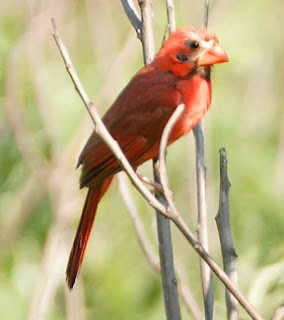




 So you may be wondering what an old bridge has to do with birding and the Minnesota Ornithologists Union, well this bridge extends through the
 Now politicians in the cities of Bloomington, who currently owns the bridge, and Eagan, which is on the opposite side of the river, as well as several state politicians have put forth a plan to tare down the existing bridge and build a boardwalk platform on the existing cement supports. The problem is that the estimated cost is $4.5 million. A large part of that cost is for the removal of the existing bridge which contains lead so that it can not be knocked down conventionally. So far the supporters of the plan have secured $1.3 million in funding but still have a long way to go. That is why 200 or more people of all types (birders, bicyclists, hikers, and families) showed up on the 14th to show our support for this great cause. At the program, which began at noon, they had speakers ranging from local and state politicians, leaders of bicycle groups, neighbors, and leaders from
 Near the same pond I also saw this ruby-throated hummingbird.
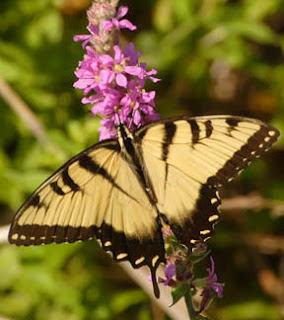
 I also took a couple of butterfly pics like this one of a common sulfur
 and this eastern comma which looks like it had seen better days.
 When I was walking back off the boardwalk I was startled by a white tail doe. She just sat and watched me as I walked past about 4 feet away.
 This was the only deer that I saw which surprised me because on my trips to Fort Snelling State Park, which borders the park in the north, I have seen plenty of deer. It turned out to be a great morning and afternoon. I got out, did some birding and helped lend my support for a good cause.